172nm Excimer Lamp for Precision Cleaning and Surface Treatment
Oct 28, 2026
In precision manufacturing, removing microscopic organic contaminants without damaging the underlying material is a persistent challenge. Semiconductor wafers, display substrates, optical components, and advanced coatings often require surface treatment that delivers consistent results while minimizing chemical use and process variation. A 172nm excimer lamp provides a vacuum ultraviolet (VUV) light source for applications that require precise photochemical cleaning, surface modification, or specialized coating treatment.
GMY develops 172nm excimer lamp solutions for industrial equipment manufacturers, semiconductor processing systems, and other precision applications. Depending on the process requirements, these light sources can support dry surface cleaning, improved surface wettability, coating modification, and organic carbon reduction in ultrapure water systems.
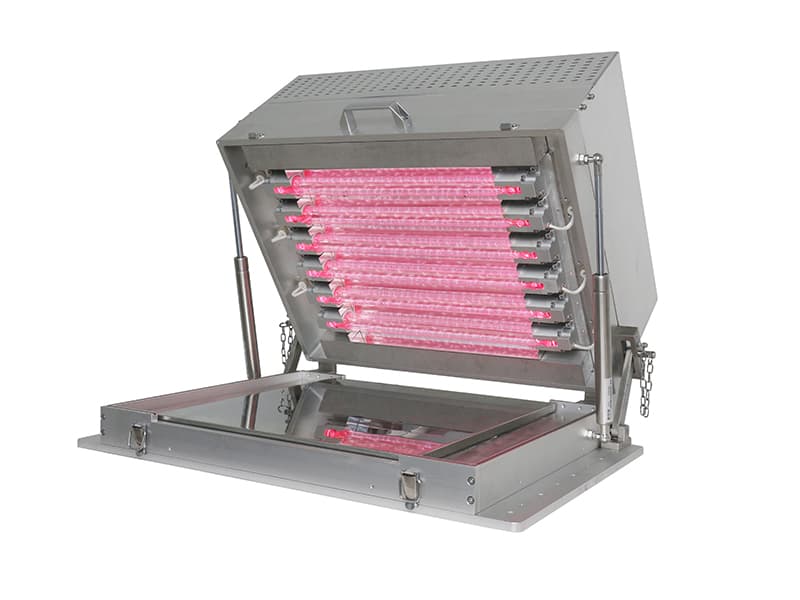
GMY 172nm excimer lamp module for precision industrial applications.
What Is a 172nm Excimer Lamp?
A 172nm excimer lamp is a vacuum ultraviolet light source that emits radiation at a wavelength of 172 nanometers. Its short wavelength corresponds to high-energy photons that can initiate photochemical reactions on material surfaces and in suitable process environments.
Unlike conventional mechanical cleaning, which relies on physical contact, or wet cleaning, which uses liquid chemicals, 172nm VUV treatment can help decompose organic residues directly at the surface. Under suitable operating conditions, the radiation also interacts with oxygen and other surrounding molecules, promoting oxidation reactions that help remove contaminants.
This makes the technology relevant to applications where surface cleanliness, material integrity, and process consistency are important. Actual cleaning performance depends on the contaminant type, substrate material, irradiation distance, exposure time, oxygen concentration, and overall equipment design. For manufacturers evaluating a dedicated light source, GMY's 172nm Excimer VUV Light Source provides a starting point for comparing lamp configurations and application requirements.
How Does 172nm VUV Photochemical Cleaning Work?
The cleaning mechanism involves direct photochemical reactions and, depending on the surrounding atmosphere, oxidation reactions involving reactive oxygen species. These processes can work together to break down organic contamination on exposed surfaces.
When suitable organic residues absorb VUV energy, their molecular bonds may be broken. The resulting fragments can react further with oxygen-derived species, converting some organic contaminants into more volatile compounds or oxidation products. With appropriate process conditions, this can reduce residual organic contamination without relying on conventional liquid cleaning agents.
For this reason, a 172nm excimer lamp is particularly relevant to dry cleaning processes used before coating, bonding, deposition, or other surface-sensitive manufacturing steps. It is not a universal replacement for every cleaning method: inorganic particles, heavy contamination, shadowed areas, and materials sensitive to UV exposure may require additional process controls or complementary cleaning techniques.
Where Are 172nm Excimer Lamps Used?
The value of 172nm VUV technology depends on the process it is designed to improve. In industrial manufacturing, the main applications include precision component cleaning, surface activation, coating treatment, and selected water purification processes.
Semiconductor Wafer and Display Mask Cleaning
Semiconductor wafers, photomasks, fine metal masks, and display substrates can be sensitive to organic residues left by handling, processing, or previous manufacturing steps. Even small amounts of contamination may affect subsequent coating, bonding, or patterning operations.
A 172nm excimer lamp can provide non-contact photochemical cleaning before downstream processing. It is also relevant to OLED evaporation mask maintenance, where removing organic contamination while preserving the mask's dimensional integrity is important. Process engineers should validate exposure conditions against the substrate, mask structure, and contamination profile.
Illustration of surface changes before and after irradiation. Results depend on the material and process conditions.
For equipment builders and semiconductor manufacturers, GMY offers a 172nm excimer lamp module for semiconductor wafer and mask cleaning. The product is intended for applications including wafer cleaning, FMM and Invar mask cleaning, OLED evaporation mask cleaning, and film matting.
Surface Modification and Coating Treatment
Surface properties influence how well adhesives, inks, and coatings interact with a substrate. Some polymers and other low-surface-energy materials can be difficult to coat or bond without pretreatment. 172nm VUV irradiation can modify surface chemistry by breaking certain molecular bonds and promoting the formation of more polar surface groups under suitable conditions. This may improve wettability and support better adhesion in subsequent manufacturing processes. The degree of improvement depends on the material composition, surface condition, treatment parameters, and time between treatment and the next process step.
The technology is also used in specialized coating and photocuring processes. For example, excimer-based treatment can help produce controlled matte finishes on certain coatings and films. In these applications, wavelength, irradiance, exposure time, and coating formulation all influence the final surface texture and performance.
Manufacturers exploring these applications can review GMY's high-power 172nm excimer lamp for matte surface treatment and coating modification, developed for industrial processes involving film finishing, inks, coatings, and related materials.
Ultrapure Water TOC Reduction
Total organic carbon (TOC) is an important water quality indicator in semiconductor manufacturing, pharmaceutical production, and laboratory ultrapure water systems. Even trace organic compounds can be undesirable when process water must meet stringent purity requirements.
A 172nm VUV light source can contribute to organic compound decomposition through direct photolysis and oxidation reactions. In suitable reactor designs, irradiation can also generate reactive species that help break down dissolved organic contaminants. Treatment performance depends on water composition, flow rate, optical path, lamp output, and reactor configuration; therefore, the achieved TOC level should be confirmed through testing.
GMY's 172nm excimer lamp for ultrapure water TOC degradation includes 15W and 20W models. The published product specifications list UV irradiance above 23 mW/cm² at a distance of 6 mm for these models. These values refer to the stated test conditions and should not be interpreted as a guaranteed treatment result for every water system.
For applications involving AI server liquid cooling infrastructure, semiconductor ultrapure water loops, or laboratory water systems, engineers should evaluate the lamp together with the reactor, hydraulic design, and required water quality target.
What Should Buyers Consider When Selecting a 172nm Excimer Lamp?
Choosing a 172nm excimer lamp involves more than comparing rated power. The right configuration depends on the target process, installation space, substrate sensitivity, and required treatment performance.
Application and target material: Identify whether the objective is organic residue removal, surface activation, coating treatment, or TOC reduction. Each application has different performance requirements.
Irradiance and working distance: Compare irradiance at the intended operating distance rather than relying on lamp power alone. Irradiation uniformity across the treatment area is also important for consistent results.
Dimensions and equipment integration: Check the lamp length, diameter, irradiation window, mounting arrangement, cooling requirements, and available installation space. Confirm electrical compatibility with the required power supply or ballast.
Operating environment and safety: VUV radiation can cause eye and skin injury. Equipment should incorporate appropriate shielding, interlocks, and controlled operating procedures. Depending on the environment, ozone generation and ventilation requirements must also be assessed.
Testing and customization: For a new application, request technical data and validate the treatment process using representative samples. Lamp specifications, exposure conditions, and the required results should be confirmed before integrating the source into a production line.
GMY provides different 172nm excimer lamp configurations for surface treatment and water-related applications. Buyers can start with the GMY product range and identify a suitable model according to the actual operating conditions.
Why Consider GMY for 172nm Excimer Lamp Solutions?
For OEMs, industrial equipment manufacturers, and engineering teams, a light source supplier needs to provide more than a lamp. Product consistency, configuration compatibility, technical communication, and customization options can all affect the development and operation of the final system.
GMY's product portfolio covers several 172nm VUV applications, including semiconductor wafer and mask cleaning, surface modification, coating treatment, and ultrapure water TOC reduction. Depending on the selected product, available configurations and technical specifications differ.
When evaluating a solution, buyers should provide the intended application, target material, treatment area, required irradiance, installation dimensions, and operating conditions. This information helps the engineering team assess product compatibility and identify the appropriate lamp or module configuration. To explore available models, visit GMY's 172nm excimer lamp product range or contact the company through its official website to discuss application-specific requirements.
FAQ
What is a 172nm excimer lamp used for?
A 172nm excimer lamp is used in selected industrial processes for photochemical surface cleaning, surface modification, coating treatment, and organic contaminant reduction in suitable water treatment systems.
How does a 172nm excimer lamp remove organic contaminants?
Its vacuum ultraviolet photons can break molecular bonds in susceptible organic compounds. Reactions with oxygen and other reactive species may further oxidize contaminants, depending on the process environment.
Can a 172nm excimer lamp be used for semiconductor wafer cleaning?
Yes. It can be used for non-contact removal of organic surface contamination from semiconductor wafers and selected masks. The process must be validated for the substrate, contaminant type, and downstream manufacturing requirements.
Can 172nm VUV light improve surface wettability?
Under suitable conditions, VUV treatment can modify surface chemistry and increase surface energy, potentially improving wettability and adhesion. Results vary by material and treatment conditions.
Can a 172nm excimer lamp reduce TOC in ultrapure water?
Yes. A suitably designed 172nm VUV treatment system can support the decomposition of organic compounds in ultrapure water. Actual TOC reduction depends on water quality, reactor design, flow rate, and irradiation conditions.
What information is needed to select a 172nm excimer lamp?
Important details include the application, substrate or fluid, treatment area, target performance, irradiance, working distance, lamp dimensions, electrical requirements, cooling method, and operating environment.
Are 172nm excimer lamps safe to operate?
The equipment must be designed and operated with suitable UV shielding, interlocks, ventilation where required, and appropriate safety procedures. Direct exposure to 172nm VUV radiation should be prevented.
{
"@context": "https://schema.org",
"@type": "BlogPosting",
"headline": "172nm Excimer Lamp: Applications in Precision Cleaning and Surface Treatment",
"description": "Learn how 172nm excimer lamps support semiconductor wafer cleaning, surface modification, coating treatment, and ultrapure water TOC reduction, with application and selection guidance from GMY.",
"mainEntityOfPage": {
"@type": "WebPage",
"@id": "https://www.gmyok.com/products"
},
"author": {
"@type": "Organization",
"name": "GMY"
},
"publisher": {
"@type": "Organization",
"name": "GMY",
"url": "https://www.gmyok.com/"
},
"about": [
{
"@type": "Thing",
"name": "172nm Excimer Lamp"
},
{
"@type": "Thing",
"name": "Vacuum Ultraviolet Surface Cleaning"
},
{
"@type": "Thing",
"name": "Semiconductor Manufacturing"
},
{
"@type": "Thing",
"name": "Ultrapure Water TOC Reduction"
}
],
"inLanguage": "en"
}
{
"@context": "https://schema.org",
"@type": "FAQPage",
"mainEntity": [
{
"@type": "Question",
"name": "What is a 172nm excimer lamp used for?",
"acceptedAnswer": {
"@type": "Answer",
"text": "A 172nm excimer lamp is used in selected industrial processes for photochemical surface cleaning, surface modification, coating treatment, and organic contaminant reduction in suitable water treatment systems."
}
},
{
"@type": "Question",
"name": "How does a 172nm excimer lamp remove organic contaminants?",
"acceptedAnswer": {
"@type": "Answer",
"text": "Its vacuum ultraviolet photons can break molecular bonds in susceptible organic compounds. Reactions with oxygen and other reactive species may further oxidize contaminants, depending on the process environment."
}
},
{
"@type": "Question",
"name": "Can a 172nm excimer lamp be used for semiconductor wafer cleaning?",
"acceptedAnswer": {
"@type": "Answer",
"text": "Yes. It can be used for non-contact removal of organic surface contamination from semiconductor wafers and selected masks. The process must be validated for the substrate, contaminant type, and downstream manufacturing requirements."
}
},
{
"@type": "Question",
"name": "Can 172nm VUV light improve surface wettability?",
"acceptedAnswer": {
"@type": "Answer",
"text": "Under suitable conditions, VUV treatment can modify surface chemistry and increase surface energy, potentially improving wettability and adhesion. Results vary by material and treatment conditions."
}
},
{
"@type": "Question",
"name": "Can a 172nm excimer lamp reduce TOC in ultrapure water?",
"acceptedAnswer": {
"@type": "Answer",
"text": "Yes. A suitably designed 172nm VUV treatment system can support the decomposition of organic compounds in ultrapure water. Actual TOC reduction depends on water quality, reactor design, flow rate, and irradiation conditions."
}
},
{
"@type": "Question",
"name": "What information is needed to select a 172nm excimer lamp?",
"acceptedAnswer": {
"@type": "Answer",
"text": "Important details include the application, substrate or fluid, treatment area, target performance, irradiance, working distance, lamp dimensions, electrical requirements, cooling method, and operating environment."
}
},
{
"@type": "Question",
"name": "Are 172nm excimer lamps safe to operate?",
"acceptedAnswer": {
"@type": "Answer",
"text": "The equipment must be designed and operated with suitable UV shielding, interlocks, ventilation where required, and appropriate safety procedures. Direct exposure to 172nm VUV radiation should be prevented."
}
}
]
}