inquiry
Leave A Message
If you are interested in our products and want to know more details,please leave a message here,we will reply you as soon as we can.
banner
Blog
  • Are 222nm Excimer Lamps the Future of Safe Disinfection
    Are 222nm Excimer Lamps the Future of Safe Disinfection
    Nov 09, 2026
    As businesses, healthcare facilities, and public institutions look for more effective ways to control airborne and surface contamination, ultraviolet disinfection technology is gaining renewed attention. However, traditional UV-C systems have an important limitation: direct exposure to conventional germicidal UV light can damage human skin and eyes, meaning many systems must operate in unoccupied spaces. This is where 222nm excimer lamps are attracting interest. Using Far-UVC technology, these lamps offer a different approach to microbial inactivation, with the potential to support continuous disinfection in occupied environments when properly filtered, designed, and installed. So, are 222nm excimer lamps the future of safe disinfection? The technology has considerable potential, particularly for healthcare, education, transportation, and commercial environments. But its long-term success depends on more than wavelength alone. Optical filtering, exposure management, product quality, and real-world performance all play important roles. 222nm Far-UVC excimer lamp technology for modern disinfection systems. What Is a 222nm Excimer Lamp? A 222nm excimer lamp is a type of ultraviolet light source that produces Far-UVC radiation at a wavelength of approximately 222 nanometers. It commonly uses a krypton-chloride (KrCl) excimer discharge to generate ultraviolet energy with strong germicidal potential. Unlike conventional low-pressure mercury UV-C lamps, which typically operate at 254nm, KrCl excimer lamps produce shorter-wavelength ultraviolet radiation. This difference is important because 222nm light has relatively limited penetration into biological tissues under properly controlled conditions. Microorganisms such as bacteria and viruses can be inactivated when exposed to sufficient Far-UVC energy. The radiation damages essential biological structures, preventing microorganisms from remaining infectious or reproducing. One of the most interesting characteristics of 222nm technology is its potential use in environments where people are present. Unlike conventional UV-C systems designed for unoccupied-room operation, appropriately engineered and filtered Far-UVC systems can be designed for continuous disinfection in occupied spaces. For businesses exploring this technology, GMY provides a range of 222nm excimer lamp products for disinfection equipment, commercial applications, and customized lighting solutions. Why Is 222nm Far-UVC Different from Traditional 254nm UV-C? Both 222nm and 254nm ultraviolet light can be used for germicidal applications, but their interaction with biological materials is different. Traditional 254nm UV-C is widely used in air, water, and surface disinfection. It is effective against many microorganisms, but direct exposure can cause photokeratitis and skin erythema. As a result, conventional 254nm systems often rely on enclosed equipment, interlocks, motion sensors, or upper-room configurations to reduce human exposure. By comparison, 222nm Far-UVC is strongly absorbed by proteins and other biological materials near the surface of human skin. This limited penetration is one reason researchers are investigating its potential for use in occupied environments. The main differences can be summarized as follows: Comparison 222nm Far-UVC 254nm UV-C Wavelength 222nm 254nm Light source KrCl excimer Typically mercury-based Germicidal application Air and surface disinfection Air, water, and surface disinfection Human exposure considerations Potential for controlled use in occupied spaces Direct exposure generally requires strict controls Mercury content Mercury-free excimer technology Common mercury lamp designs contain mercury The key distinction is not simply that one wavelength is safer than another. The actual emission spectrum, optical filtering, irradiance, exposure duration, and installation design determine whether a UV disinfection system can be used safely. Is 222nm UV Light Safe for Human Skin and Eyes? Safety is probably the most important question surrounding 222nm excimer lamps. Research suggests that properly filtered 222nm Far-UVC can have a favorable safety profile compared with conventional germicidal UV-C. Its limited penetration into biological tissues reduces the likelihood of reaching deeper living cells under appropriately controlled exposure conditions. However, it is important to understand that 222nm UV light should not automatically be considered harmless. KrCl excimer lamps may produce unwanted longer-wavelength emissions. These emissions can increase biological exposure risks if they are not adequately controlled. This is why optical bandpass filters are an important component of many Far-UVC systems. A 2024 study published in Photochemistry and Photobiology examined the influence of optical filters on commercially available Far-UVC lamps. The researchers highlighted that relying only on a single-wavelength irradiance measurement at 222nm may underestimate total biological exposure. Full spectral measurements and appropriate exposure-limit calculations are therefore important. When evaluating a 222nm disinfection lamp, buyers should pay attention to several factors: Optical filtering: Does the lamp use an appropriate filter to suppress unwanted longer-wavelength emissions? Spectral output: Is the complete emission spectrum measured and documented? Exposure limits: Does the system operate within applicable photobiological exposure guidelines? Installation design: Are lamp positioning, mounting height, irradiance distribution, and exposure duration properly assessed? Independent testing: Are safety and performance claims supported by relevant test reports? For commercial projects, these details matter just as much as the rated power or advertised sterilization performance. How Effective Are 222nm Excimer Lamps Against Microorganisms? 222nm Far-UVC has demonstrated promising antimicrobial performance against a range of bacteria, viruses, and other microorganisms in laboratory studies. Its germicidal action works by delivering ultraviolet energy that damages essential biological components. Depending on the microorganism, exposure conditions, and delivered UV dose, this can prevent further replication or reduce infectivity. However, disinfection performance is not determined by wavelength alone. Three factors are particularly important: UV intensity: Higher irradiance can deliver the required UV dose in a shorter period, depending on the target microorganism and system configuration. Exposure time: Microbial inactivation generally increases with sufficient exposure. A system designed for continuous operation may provide cumulative exposure that differs from a short-duration treatment process. Environmental conditions: Air movement, distance from the light source, surface characteristics, shadowing, and organic contamination can all influence real-world performance. This is especially relevant when selecting equipment for HVAC systems, commercial air purifiers, or large indoor spaces. A lamp that performs well under laboratory conditions may require different configurations to achieve comparable results in a real installation. For OEM manufacturers and commercial equipment suppliers, GMY's 222nm Far-UVC Excimer Lamp Disinfection Module offers a product option for integrating Far-UVC technology into customized disinfection equipment. Where Can 222nm Excimer Lamps Be Used? One of the strongest advantages of Far-UVC technology is its potential application in indoor environments that remain occupied throughout the day. This makes it particularly interesting for facilities where shutting down normal operations for disinfection is inconvenient or impractical. Hospitals and healthcare facilities Hospitals, clinics, and medical waiting areas experience continuous movement of patients, healthcare workers, and visitors. Properly designed 222nm systems may help reduce airborne microbial contamination as part of a broader infection-control strategy. Schools and educational institutions Classrooms, libraries, and cafeterias often have high occupancy and shared indoor air. Far-UVC technology offers another potential approach to improving environmental hygiene without requiring regular room evacuation, subject to exposure compliance. Offices and commercial buildings Modern offices, conference rooms, and shared workspaces can benefit from continuous air-treatment solutions. Far-UVC systems may complement ventilation and filtration to support better indoor environmental management. Public transportation and elevators Elevators, buses, railway carriages, and airport terminals experience frequent passenger turnover. Compact 222nm disinfection modules can be integrated into equipment designed for these high-traffic environments. Far-UVC disinfection module designed for commercial and industrial integration. For elevator and transportation equipment manufacturers, GMY also offers a range of 222nm Far-UVC lighting solutions that can be considered for different installation requirements. What Should Buyers Consider When Choosing a 222nm Excimer Lamp? For distributors, system integrators, and OEM equipment manufacturers, selecting a 222nm lamp requires more than comparing wattage and product prices. The following considerations can help buyers evaluate different products more effectively. Wavelength accuracy and spectral purity Confirm that the light source operates at the intended 222nm wavelength and request complete spectral emission data. For occupied-space applications, the optical filter specification is particularly important. UV irradiance and coverage Check the irradiance at a specified measurement distance rather than comparing power ratings alone. The installation environment and required disinfection coverage should determine the appropriate output. Service life and operating stability Commercial equipment manufacturers need consistent performance and predictable maintenance requirements. Review rated lamp life, switching-cycle performance, operating temperature, and output stability. Electrical and mechanical compatibility OEM buyers should check input voltage, dimensions, heat management, installation methods, and control-system compatibility before selecting a module. Compliance and documentation Request applicable safety documentation, test reports, product certifications, and technical datasheets. Requirements may differ between North America, the European Union, and other target markets. GMY's 222nm product range includes different configurations for commercial and industrial applications. For example, its 20±2W excimer disinfection module features DC 24V input, a UV output rise time of approximately 3 seconds to 90%, more than 200,000 switching cycles, and a rated service life exceeding 3,000 hours according to the published product specifications. Buyers can review the GMY 222nm excimer disinfection module specifications for more technical information. Why 222nm Excimer Lamps Are Gaining Attention in the Disinfection Market The demand for advanced disinfection technology is being influenced by several practical considerations. First, businesses increasingly want disinfection systems that can operate without interrupting normal activities. Technologies designed for occupied spaces are therefore attracting attention from healthcare operators, building managers, and commercial equipment manufacturers. Second, chemical-free disinfection is an attractive option for facilities looking to reduce dependence on chemical consumables and avoid chemical residues. UV-based treatment uses physical energy rather than conventional chemical disinfectants, although it does not replace all cleaning and sanitation procedures. Third, mercury-free light sources are becoming more relevant as businesses consider environmental requirements and product lifecycle management. KrCl excimer lamps offer an alternative to mercury-based UV-C sources, although their overall environmental impact still depends on manufacturing, energy consumption, and disposal. Finally, advances in optical filtering, lamp design, and electronic control are helping manufacturers develop more application-specific Far-UVC equipment. These factors make 222nm excimer lamps an important technology to watch in the development of next-generation disinfection systems. Is 222nm Excimer Technology Ready to Replace Traditional Disinfection? Not entirely. Although 222nm Far-UVC has significant potential, it should be viewed as a complementary disinfection technology rather than a complete replacement for traditional UV-C, ventilation, air filtration, or routine cleaning. Different applications require different solutions. For example, conventional 254nm UV-C remains widely used in enclosed water-treatment systems and unoccupied-space disinfection equipment. Meanwhile, properly filtered 222nm Far-UVC may be more suitable for projects that require continuous operation in occupied indoor environments. There are also practical challenges that manufacturers and buyers need to address, including initial equipment costs, exposure assessment, installation requirements, long-term performance validation, and regulatory compliance. The future of Far-UVC will depend on how effectively these technical and commercial challenges are addressed. Manufacturers that can provide reliable products, accurate spectral data, and application-specific engineering support will be better positioned to serve this growing market. GMY: 222nm Excimer Lamp Solutions for OEM and Industrial Applications As a professional UV light source manufacturer, GMY Lighting Technology focuses on developing ultraviolet lighting products for industrial, commercial, and specialized applications. GMY's 222nm Far-UVC product range includes excimer lamps and integrated disinfection modules designed for different equipment configurations and operating environments. Key product advantages include: Multiple power configurations: Options including 15W, 20W-class modules, 75W, and 150W solutions for different application requirements. Mercury-free technology: KrCl excimer light sources provide an alternative to conventional mercury-based UV-C lamps. Flexible integration: Product configurations for air disinfection equipment, commercial fixtures, and OEM applications. Technical customization: Support for application-specific product configurations and equipment integration. Industrial applications: Solutions for healthcare, transportation, education, commercial buildings, and other disinfection projects. GMY Far-UVC excimer light source for professional disinfection equipment. Whether you are developing a new air purification system, sourcing UV components for commercial equipment, or expanding your wholesale lighting product range, GMY can help you explore suitable 222nm excimer lamp configurations. Explore the GMY 222nm Excimer Lamp product range or visit the UV disinfection solutions page to learn more about available technologies. For OEM/ODM inquiries, customized specifications, or wholesale requirements, contact GMY to discuss your project and request detailed product information. Frequently Asked Questions About 222nm Excimer Lamps Are 222nm excimer lamps safe for occupied spaces? Properly filtered and engineered 222nm excimer lamps can be designed for use in occupied spaces. However, safety depends on spectral purity, optical filtering, exposure limits, and installation conditions. They should not be assumed to be harmless without appropriate testing. What is the difference between 222nm and 254nm UV lamps? 222nm lamps typically use KrCl excimer technology and produce Far-UVC radiation with limited penetration into biological tissues. Conventional 254nm lamps are commonly mercury-based and require stricter controls against direct human exposure. Can 222nm Far-UVC kill airborne viruses and bacteria? Yes. Laboratory research has demonstrated that 222nm Far-UVC can inactivate various airborne viruses and bacteria when sufficient UV doses are delivered. Actual performance depends on the microorganism, irradiance, exposure time, and environmental conditions. Do 222nm excimer lamps contain mercury? No. KrCl excimer lamps use krypton and chlorine-based excimer technology rather than mercury vapor, making them a mercury-free alternative to conventional mercury-based UV-C lamps. Do 222nm excimer lamps produce ozone? Ozone generation depends on the emission spectrum and lamp design. Properly engineered 222nm systems can be designed to minimize ozone generation. Buyers should request product-specific ozone test data rather than assume all UV lamps have identical emissions. Where are 222nm excimer lamps commonly used? Potential applications include hospitals, clinics, schools, offices, elevators, public transportation, commercial buildings, and integrated air purification equipment. What should I check before purchasing a 222nm excimer lamp? Important factors include wavelength accuracy, spectral filtering, UV irradiance, lamp lifespan, electrical specifications, exposure safety, product certifications, and compatibility with the intended equipment. Does GMY provide customized 222nm excimer lamp solutions? GMY offers 222nm excimer lamps and disinfection modules for commercial and industrial applications, with product configurations and OEM/ODM support for equipment manufacturers and distributors. Buyers can contact GMY to discuss specific technical requirements. { "@context": "https://schema.org", "@type": "FAQPage", "mainEntity": [ { "@type": "Question", "name": "Are 222nm excimer lamps safe for occupied spaces?", "acceptedAnswer": { "@type": "Answer", "text": "Properly filtered and engineered 222nm excimer lamps can be designed for use in occupied spaces. Safety depends on spectral purity, optical filtering, exposure limits, and installation conditions. They should not be assumed to be harmless without appropriate testing." } }, { "@type": "Question", "name": "What is the difference between 222nm and 254nm UV lamps?", "acceptedAnswer": { "@type": "Answer", "text": "222nm lamps typically use KrCl excimer technology and produce Far-UVC radiation with limited penetration into biological tissues. Conventional 254nm lamps are commonly mercury-based and require stricter controls against direct human exposure." } }, { "@type": "Question", "name": "Can 222nm Far-UVC kill airborne viruses and bacteria?", "acceptedAnswer": { "@type": "Answer", "text": "Laboratory research has demonstrated that 222nm Far-UVC can inactivate various airborne viruses and bacteria when sufficient UV doses are delivered. Actual performance depends on the microorganism, irradiance, exposure time, and environmental conditions." } }, { "@type": "Question", "name": "Do 222nm excimer lamps contain mercury?", "acceptedAnswer": { "@type": "Answer", "text": "No. KrCl excimer lamps use krypton and chlorine-based excimer technology rather than mercury vapor, making them a mercury-free alternative to conventional mercury-based UV-C lamps." } }, { "@type": "Question", "name": "Do 222nm excimer lamps produce ozone?", "acceptedAnswer": { "@type": "Answer", "text": "Ozone generation depends on the emission spectrum and lamp design. Properly engineered 222nm systems can be designed to minimize ozone generation. Buyers should request product-specific ozone test data." } }, { "@type": "Question", "name": "Where are 222nm excimer lamps commonly used?", "acceptedAnswer": { "@type": "Answer", "text": "Potential applications include hospitals, clinics, schools, offices, elevators, public transportation, commercial buildings, and integrated air purification equipment." } }, { "@type": "Question", "name": "What should I check before purchasing a 222nm excimer lamp?", "acceptedAnswer": { "@type": "Answer", "text": "Important factors include wavelength accuracy, spectral filtering, UV irradiance, lamp lifespan, electrical specifications, exposure safety, product certifications, and compatibility with the intended equipment." } }, { "@type": "Question", "name": "Does GMY provide customized 222nm excimer lamp solutions?", "acceptedAnswer": { "@type": "Answer", "text": "GMY offers 222nm excimer lamps and disinfection modules for commercial and industrial applications, with product configurations and OEM/ODM support for equipment manufacturers and distributors. Buyers can contact GMY to discuss specific technical requirements." } } ] }
  • Traditional UV Lamps vs 172nm Excimer Lamps A Comparison
    Traditional UV Lamps vs 172nm Excimer Lamps A Comparison
    Nov 06, 2026
    Ultraviolet technology is widely used in industrial manufacturing, surface treatment, water purification, printing, coating, and disinfection. However, not all UV light sources work in the same way. Traditional UV lamps, including mercury-based UV lamps, and 172nm excimer lamps differ significantly in wavelength, emission characteristics, photochemical effects, and suitable applications. For manufacturers evaluating a new UV process, choosing the right light source is not simply a matter of comparing lamp power or output intensity. The more important question is whether the wavelength and radiation characteristics can achieve the required chemical reaction, surface condition, or treatment result. So, what is the difference between traditional UV lamps and 172nm excimer lamps? Traditional UV sources remain effective for many established curing and disinfection processes, while 172nm vacuum ultraviolet (VUV) technology offers specific advantages in organic contaminant removal, surface activation, and specialized coating modification. GMY Lighting Technology Co., Ltd. develops 172nm excimer lamps and UV light modules for industrial applications, including semiconductor cleaning, surface modification, photocuring, and ultrapure water treatment. This comparison explains how the two technologies work, where they differ, and how manufacturers can determine which UV source is more suitable for their production requirements. What Are Traditional UV Lamps? Traditional UV lamps refer to established ultraviolet light sources used in industrial, commercial, and environmental applications. Depending on the lamp design, they may emit a relatively broad spectrum or concentrate their output around specific ultraviolet wavelengths. Mercury vapor lamps are a common example. Low-pressure mercury lamps are widely associated with emission lines around 185nm and 254nm, while medium-pressure mercury lamps produce a broader range of UV wavelengths. Different lamp types are selected according to the photochemical reaction or treatment process required. Traditional UV lamps are commonly used for: UV curing of inks, coatings, adhesives, and printing materials. UV-C disinfection of air, water, and exposed surfaces. Photochemical oxidation and organic contaminant treatment. Industrial water and wastewater treatment. General UV processing in manufacturing equipment. One important advantage of conventional UV technology is its established industrial infrastructure. Many production lines already use mercury UV lamps, with compatible power supplies, reflectors, cooling systems, and process parameters. For example, GMY provides different mercury UV lamps for applications including water treatment and UV disinfection. These products serve different requirements from specialized 172nm VUV sources and should be evaluated according to the intended process. The performance of a traditional UV lamp depends on its emission spectrum, irradiance, operating conditions, lamp age, distance from the target, and the optical properties of the material being treated. Therefore, the term traditional UV lamp covers several technologies rather than one standardized light source. What Is a 172nm Excimer Lamp? A 172nm excimer lamp is a vacuum ultraviolet light source that emits narrow-band radiation centered around 172 nanometers. It is commonly based on xenon excimer discharge technology and produces high-energy VUV photons for specialized photochemical processes. At 172nm, the photon energy is approximately 7.2 eV. This relatively high photon energy allows the radiation to initiate photochemical reactions that are useful for breaking down organic contaminants and modifying material surfaces. Unlike many conventional UV processes that rely on photoinitiators or longer-wavelength radiation, 172nm excimer technology can directly contribute to the decomposition of organic molecules at exposed surfaces. It can also interact with oxygen and water molecules in the surrounding environment, producing reactive species that participate in oxidation reactions. This makes 172nm excimer lamps particularly relevant to processes where surface cleanliness, surface energy, or controlled photochemical modification is more important than deep penetration into a thick material. GMY's 172nm Excimer VUV Light Source is designed for semiconductor wafers, display substrates, optical components, and other precision surface-processing applications. Depending on the model, GMY's product specifications include power ratings from 5W to 1000W, with different tube dimensions, cooling methods, emission lengths, and irradiance levels. Custom specifications for lamp power, size, and matching power supplies are also available according to application requirements. Traditional UV Lamps vs. 172nm Excimer Lamps: Key Differences The main difference between traditional UV lamps and 172nm excimer lamps is their spectral output and the way their radiation interacts with materials. Traditional UV sources cover multiple wavelength ranges and support a broad range of established processes. A 172nm excimer lamp provides a more specific VUV output for targeted surface photochemistry. Comparison Factor Traditional UV Lamps 172nm Excimer Lamps Wavelength Varies by lamp type, such as 185nm, 254nm, or broad-spectrum UV Narrow-band VUV output centered around 172nm Photon Energy Depends on the emitted wavelength Approximately 7.2 eV per photon Main Mechanism Photochemical reactions, photoinitiator activation, or germicidal effects depending on the source High-energy VUV photochemistry and surface oxidation Penetration Depends on wavelength, material, and formulation Strongly surface-oriented because 172nm radiation is readily absorbed by air and many materials Surface Cleaning Available with suitable UV oxidation systems Well suited to removing thin organic contamination from exposed surfaces Surface Modification Possible depending on wavelength and process chemistry Useful for surface activation, hydrophilicity, and adhesion improvement Industrial Applications General curing, printing, disinfection, and water treatment Precision cleaning, surface modification, specialized curing, and VUV oxidation Mercury Content Mercury-based lamps contain mercury GMY's 172nm excimer lamps are mercury-free This comparison is a general technical guide. Traditional UV lamps cover several different technologies, so the actual performance of a specific lamp should always be evaluated using its spectral output and product specifications. How Wavelength Affects UV Processing Performance Wavelength is one of the most important factors when selecting an industrial UV light source. It determines photon energy and influences how radiation is absorbed by the target material, coating, surrounding gas, and process medium. Shorter wavelengths generally carry more energy per photon. However, higher photon energy does not automatically mean better performance for every application. The absorption characteristics of the material and the required reaction must also be considered. For example, 172nm VUV radiation is strongly absorbed by oxygen and many organic materials. This makes it useful for surface-focused photochemical reactions, but it also means that the lamp generally needs to operate close to the target surface under suitable atmospheric or controlled-gas conditions. By comparison, longer-wavelength UV radiation may penetrate certain coatings or materials more effectively, depending on their optical properties and the formulation being processed. For manufacturers, the correct question is therefore not simply which UV lamp has the highest photon energy. It is which wavelength provides the required reaction at the correct depth, within the available process conditions. Why 172nm Excimer Lamps Are Used for Precision Surface Cleaning Organic contamination on material surfaces can affect bonding, coating adhesion, wettability, and downstream manufacturing quality. Even a thin layer of organic residue may create problems in processes that require clean and consistent interfaces. 172nm excimer lamps offer a dry photochemical cleaning method for removing organic contaminants from exposed surfaces. High-energy VUV photons can break molecular bonds, while oxygen-related reactions help oxidize organic residues into smaller compounds. Typical applications include: Semiconductor wafer cleaning: Removing organic contamination before bonding, coating, or other precision processing steps. Photomask and FMM cleaning: Supporting the removal of organic residues from fine metal masks and photomasks. Display substrate treatment: Preparing glass and other display materials for subsequent manufacturing processes. Optical component cleaning: Improving surface cleanliness before coating or assembly. Battery material modification: Supporting surface cleaning and activation for selected battery-related materials. GMY offers specialized 172nm excimer lamp modules for semiconductor cleaning, mask treatment, surface modification, and other industrial applications. For applications involving delicate substrates, process validation is essential. Irradiance, exposure time, lamp-to-surface distance, gas conditions, and substrate compatibility should be evaluated before production deployment. 172nm Excimer Lamps for Surface Activation and Photocuring Beyond cleaning, 172nm excimer technology can also be used to modify surface properties and initiate selected photochemical reactions in coatings and polymer systems. Surface activation is particularly useful when a material requires improved wettability or adhesion before a subsequent coating, bonding, or deposition process. By removing surface contamination and changing surface chemistry, VUV treatment can help prepare a material for the next manufacturing step. In coating applications, 172nm excimer radiation can contribute to surface crosslinking and controlled surface texture formation. Depending on the coating formulation and process design, this may help create matte finishes, anti-fingerprint characteristics, or specific surface effects. GMY's product portfolio includes high-power 172nm excimer solutions for applications such as: Paint protection films and automotive coatings. Soft-touch panels and decorative surfaces. Paper and packaging inks. Furniture coatings and industrial inks. PCB inks and adhesive coatings. Selected 3D printing and polymer coating processes. For some coating systems, excimer treatment may be integrated with conventional UV curing. The excimer stage can create a specific surface effect, while a subsequent UV process completes curing through the coating layer. The actual sequence depends on the coating chemistry and production requirements. This is an important distinction: 172nm excimer lamps are not automatically a replacement for every conventional UV curing lamp. They are often most effective when used for a specific surface reaction within a properly designed process. 172nm Excimer Technology for Ultrapure Water TOC Reduction Another important application of 172nm VUV technology is the treatment of ultrapure water. In semiconductor manufacturing, pharmaceutical production, and laboratory systems, trace organic contaminants can affect water quality and downstream processes. Total organic carbon (TOC) is a key parameter used to evaluate organic contamination in water. A 172nm excimer light source can promote photochemical reactions that break down organic compounds and generate reactive species that contribute to oxidation. GMY provides a dedicated 172nm excimer lamp for ultrapure water TOC degradation. The product range includes 15W and 20W models, with a listed UV irradiance greater than 23 mW/cm² at 6mm. These lamps are designed for water-treatment applications where compact VUV light sources can be integrated into suitable treatment systems. Their use requires consideration of reactor design, water flow, exposure conditions, optical transmission, and the characteristics of the organic contaminants. For semiconductor UPW systems, laboratory water equipment, and other high-purity applications, the treatment system should be validated using actual water quality measurements rather than relying only on lamp power or nominal wavelength. When Should You Choose a Traditional UV Lamp? Traditional UV lamps remain a practical choice for many industrial processes. If your production line already uses a compatible mercury UV system and the existing wavelength achieves the required curing, disinfection, or oxidation performance, replacing it may not provide a meaningful operational benefit. Traditional UV lamps may be more suitable when: Your coating formulation is designed for conventional UV curing wavelengths. You need UV-C radiation for established air, water, or surface disinfection systems. Your process requires a specific emission spectrum or penetration profile. Your equipment is already optimized for an existing mercury UV lamp. Your application does not require the specialized surface photochemistry associated with 172nm VUV radiation. For example, GMY's mercury lamp product range includes 185nm TOC reduction lamps and UV-C germicidal products. These products address different treatment requirements and should not be confused with 172nm excimer sources. The best choice depends on the process objective, not on whether a lamp is considered traditional or advanced. When Is a 172nm Excimer Lamp the Better Choice? A 172nm excimer lamp is worth evaluating when the production process requires high-energy VUV photochemistry, precision organic contaminant removal, or surface modification that is difficult to achieve with the existing UV source. It may be particularly relevant when: You need to remove thin organic contamination from a precision material surface. You want to improve surface wettability or prepare a material for bonding and coating. Your process involves semiconductor wafers, display substrates, photomasks, or optical components. You need a specialized VUV source for selected coating or surface-curing applications. You are developing an ultrapure water system requiring advanced organic contaminant oxidation. You prefer a mercury-free light source for the relevant industrial process. However, 172nm radiation has important engineering considerations. It is strongly absorbed by air, and its interaction with oxygen can generate ozone. Therefore, lamp installation, gas flow, shielding, exhaust ventilation, and operator protection must be designed according to the application and relevant safety requirements. Because VUV radiation is strongly surface-oriented, it is also not suitable for every thick-film curing or deep-penetration application. Testing with the actual substrate and process chemistry is the most reliable way to determine whether it offers a measurable advantage. How to Select the Right UV Light Source for Your Production Line Before selecting a traditional UV lamp or 172nm excimer lamp, manufacturers should define the process objective and identify the performance requirements that matter most. The following factors can help guide the evaluation: Identify the Required Treatment Result Determine whether the main objective is curing, disinfection, organic contaminant removal, surface activation, hydrophilic modification, or TOC reduction. Different objectives require different wavelengths and process configurations. Evaluate the Material and Its Surface Properties Consider the substrate material, coating composition, thickness, optical absorption, temperature sensitivity, and surface condition. These factors influence how effectively the UV radiation can reach and react with the target material. Check Irradiance and Exposure Requirements Lamp power alone does not determine process performance. Irradiance at the working distance, exposure time, lamp geometry, beam uniformity, and total delivered dose all need to be considered. Review Equipment Integration Requirements Confirm the available installation space, power supply, cooling method, gas conditions, ventilation, shielding, and control interface. For 172nm systems, the optical path and atmosphere around the treatment area are particularly important. Request Application Testing Before committing to a production system, test the selected light source using representative samples. Measure the results that matter to your process, such as surface cleanliness, contact angle, adhesion, coating appearance, or TOC concentration. For customized industrial systems, GMY can discuss lamp dimensions, power requirements, and matching power supplies according to the intended application. Buyers can share their process details through the GMY contact page to explore suitable UV and VUV solutions. Why Consider GMY for 172nm Excimer Lamp Solutions? GMY Lighting Technology Co., Ltd. is a lighting technology manufacturer based in Guangdong, China. The company develops and supplies ultraviolet, infrared, halogen, IPL, and LED lighting products for industrial and commercial applications. GMY's 172nm excimer product range covers several application areas, including: Semiconductor wafer and photomask cleaning. FMM and Invar mask surface treatment. Display substrate and optical component cleaning. Industrial coating modification and photocuring. Hydrophilic surface activation. Ultrapure water TOC reduction. The company offers different lamp configurations and product models to support varied installation requirements. Its published 172nm VUV specifications include multiple power levels, tube dimensions, cooling methods, and emission lengths. Custom lamp dimensions, power, and matching power supplies can also be discussed according to the application. For engineering teams, selecting a lamp is only one part of the process. The optical arrangement, operating environment, control system, and treatment parameters also influence the final result. Working with a supplier that can discuss these factors is useful when evaluating a new VUV application. To explore GMY's available models and application options, visit the 172nm Excimer Lamp product category or review the detailed product specifications on the website. Traditional UV Lamps vs. 172nm Excimer Lamps: Frequently Asked Questions What is the main difference between traditional UV lamps and 172nm excimer lamps? The main difference is their wavelength and photochemical behavior. Traditional UV lamps cover different wavelength ranges and are used for general curing, disinfection, and oxidation. A 172nm excimer lamp emits narrow-band vacuum ultraviolet radiation that is particularly useful for surface cleaning, surface activation, and specialized photochemical processes. Is a 172nm excimer lamp better than a traditional mercury UV lamp? Not for every application. A 172nm excimer lamp may be more suitable for precision surface cleaning and modification, while traditional mercury UV lamps remain effective for many established curing, disinfection, and water-treatment processes. The correct choice depends on the material, process objective, and required wavelength. What is the photon energy of a 172nm excimer lamp? A 172nm photon carries approximately 7.2 electron volts (eV) of energy. This high photon energy supports photochemical reactions involved in organic contaminant decomposition and surface modification. Can a 172nm excimer lamp replace a conventional UV curing lamp? Not universally. A 172nm excimer lamp is often used for surface-focused photochemical reactions, while conventional UV curing systems may be needed for curing through thicker coating layers. Some industrial coating lines use excimer treatment together with a conventional UV curing stage. What materials can be treated with 172nm excimer lamps? Depending on the process conditions, 172nm excimer lamps can be used for surface cleaning and modification of semiconductor wafers, display substrates, optical components, metals, battery-related materials, and selected polymer or coating surfaces. Material compatibility and treatment results should be confirmed through testing. Why is 172nm radiation suitable for organic contaminant removal? High-energy VUV photons can break molecular bonds in organic contaminants. Reactions involving oxygen and other surrounding molecules can further oxidize the residues, helping clean exposed material surfaces without relying on conventional wet chemical cleaning. Do 172nm excimer lamps generate ozone? 172nm radiation can interact with oxygen in the surrounding atmosphere and generate ozone. System design should therefore consider the operating atmosphere, enclosure, exhaust ventilation, and applicable safety requirements. Are GMY 172nm excimer lamps mercury-free? Yes. GMY describes its 172nm excimer lamps as mercury-free VUV light sources. This is different from conventional mercury-based UV lamps, which contain mercury as part of their discharge technology. What should I provide when requesting a customized 172nm excimer lamp? Provide the intended application, target material, required treatment result, installation dimensions, available power supply, working distance, cooling conditions, and expected operating environment. These details help the supplier evaluate suitable lamp configurations and integration requirements. { "@context": "https://schema.org", "@type": "BlogPosting", "headline": "Traditional UV Lamps vs 172nm Excimer Lamps: A Comparison", "description": "Compare traditional UV lamps and 172nm excimer lamps by wavelength, photon energy, photochemical mechanisms, surface treatment performance, industrial applications, and system selection.", "author": { "@type": "Organization", "name": "GMY Lighting Technology" }, "publisher": { "@type": "Organization", "name": "GMY Lighting Technology Co., Ltd.", "url": "https://www.gmyok.com/" }, "mainEntityOfPage": { "@type": "WebPage", "@id": "https://www.gmyok.com/" }, "about": [ { "@type": "Thing", "name": "Traditional UV Lamps" }, { "@type": "Thing", "name": "172nm Excimer Lamps" }, { "@type": "Thing", "name": "Vacuum Ultraviolet Technology" }, { "@type": "Thing", "name": "UV Surface Cleaning" }, { "@type": "Thing", "name": "Surface Modification" }, { "@type": "Thing", "name": "UV Photocuring" } ] } { "@context": "https://schema.org", "@type": "FAQPage", "mainEntity": [ { "@type": "Question", "name": "What is the main difference between traditional UV lamps and 172nm excimer lamps?", "acceptedAnswer": { "@type": "Answer", "text": "The main difference is their wavelength and photochemical behavior. Traditional UV lamps cover different wavelength ranges and are used for general curing, disinfection, and oxidation. A 172nm excimer lamp emits narrow-band vacuum ultraviolet radiation that is particularly useful for surface cleaning, surface activation, and specialized photochemical processes." } }, { "@type": "Question", "name": "Is a 172nm excimer lamp better than a traditional mercury UV lamp?", "acceptedAnswer": { "@type": "Answer", "text": "Not for every application. A 172nm excimer lamp may be more suitable for precision surface cleaning and modification, while traditional mercury UV lamps remain effective for many established curing, disinfection, and water-treatment processes. The correct choice depends on the material, process objective, and required wavelength." } }, { "@type": "Question", "name": "What is the photon energy of a 172nm excimer lamp?", "acceptedAnswer": { "@type": "Answer", "text": "A 172nm photon carries approximately 7.2 electron volts (eV) of energy. This high photon energy supports photochemical reactions involved in organic contaminant decomposition and surface modification." } }, { "@type": "Question", "name": "Can a 172nm excimer lamp replace a conventional UV curing lamp?", "acceptedAnswer": { "@type": "Answer", "text": "Not universally. A 172nm excimer lamp is often used for surface-focused photochemical reactions, while conventional UV curing systems may be needed for curing through thicker coating layers. Some industrial coating lines use excimer treatment together with a conventional UV curing stage." } }, { "@type": "Question", "name": "What materials can be treated with 172nm excimer lamps?", "acceptedAnswer": { "@type": "Answer", "text": "Depending on the process conditions, 172nm excimer lamps can be used for surface cleaning and modification of semiconductor wafers, display substrates, optical components, metals, battery-related materials, and selected polymer or coating surfaces. Material compatibility and treatment results should be confirmed through testing." } }, { "@type": "Question", "name": "Why is 172nm radiation suitable for organic contaminant removal?", "acceptedAnswer": { "@type": "Answer", "text": "High-energy VUV photons can break molecular bonds in organic contaminants. Reactions involving oxygen and other surrounding molecules can further oxidize the residues, helping clean exposed material surfaces without relying on conventional wet chemical cleaning." } }, { "@type": "Question", "name": "Do 172nm excimer lamps generate ozone?", "acceptedAnswer": { "@type": "Answer", "text": "172nm radiation can interact with oxygen in the surrounding atmosphere and generate ozone. System design should therefore consider the operating atmosphere, enclosure, exhaust ventilation, and applicable safety requirements." } }, { "@type": "Question", "name": "Are GMY 172nm excimer lamps mercury-free?", "acceptedAnswer": { "@type": "Answer", "text": "Yes. GMY describes its 172nm excimer lamps as mercury-free VUV light sources. This is different from conventional mercury-based UV lamps, which contain mercury as part of their discharge technology." } }, { "@type": "Question", "name": "What should I provide when requesting a customized 172nm excimer lamp?", "acceptedAnswer": { "@type": "Answer", "text": "Provide the intended application, target material, required treatment result, installation dimensions, available power supply, working distance, cooling conditions, and expected operating environment. These details help the supplier evaluate suitable lamp configurations and integration requirements." } } ] }
  • 172nm Excimer Lamp for Precision Cleaning and Surface Treatment
    172nm Excimer Lamp for Precision Cleaning and Surface Treatment
    Oct 28, 2026
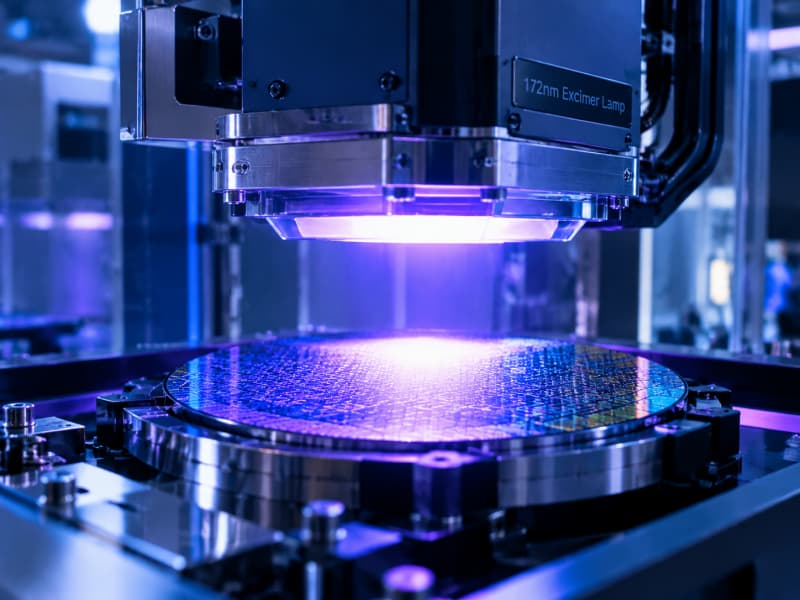
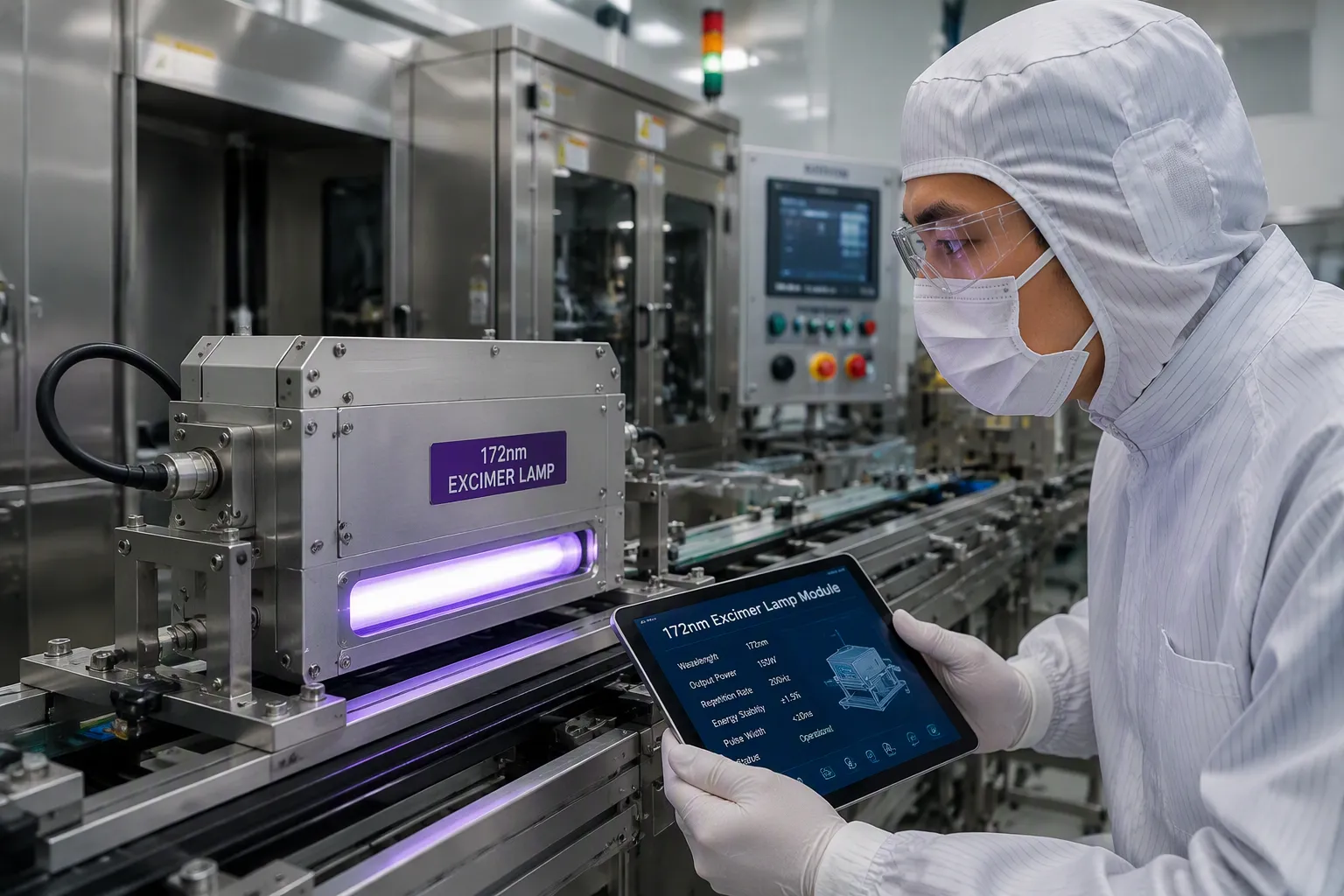
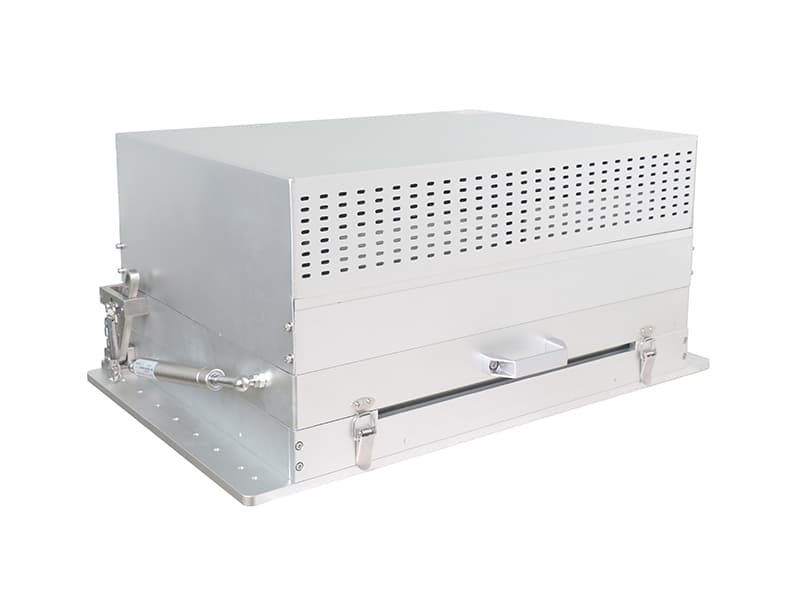
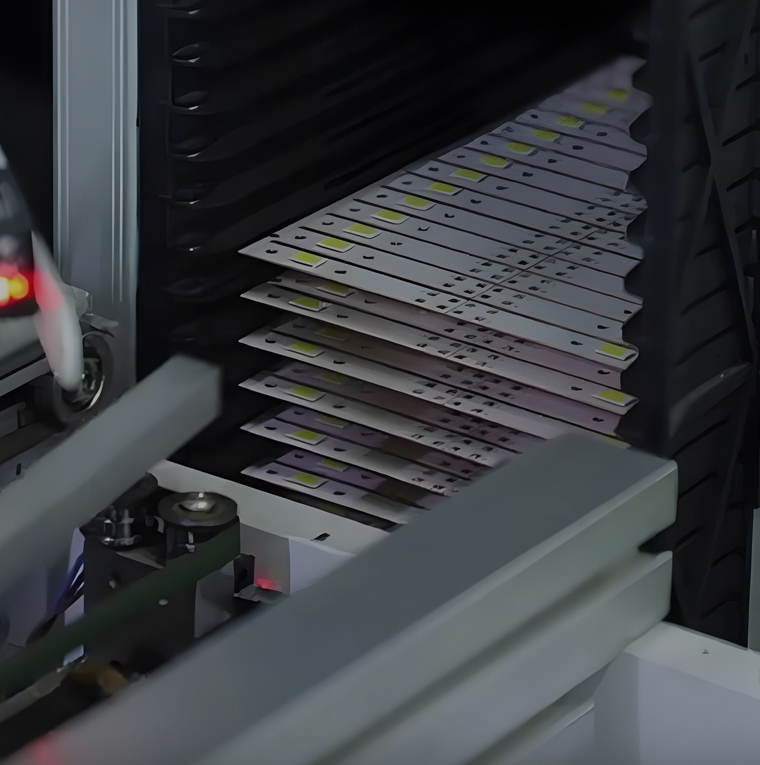
    In precision manufacturing, removing microscopic organic contaminants without damaging the underlying material is a persistent challenge. Semiconductor wafers, display substrates, optical components, and advanced coatings often require surface treatment that delivers consistent results while minimizing chemical use and process variation. A 172nm excimer lamp provides a vacuum ultraviolet (VUV) light source for applications that require precise photochemical cleaning, surface modification, or specialized coating treatment.   GMY develops 172nm excimer lamp solutions for industrial equipment manufacturers, semiconductor processing systems, and other precision applications. Depending on the process requirements, these light sources can support dry surface cleaning, improved surface wettability, coating modification, and organic carbon reduction in ultrapure water systems. GMY 172nm excimer lamp module for precision industrial applications. What Is a 172nm Excimer Lamp? A 172nm excimer lamp is a vacuum ultraviolet light source that emits radiation at a wavelength of 172 nanometers. Its short wavelength corresponds to high-energy photons that can initiate photochemical reactions on material surfaces and in suitable process environments.   Unlike conventional mechanical cleaning, which relies on physical contact, or wet cleaning, which uses liquid chemicals, 172nm VUV treatment can help decompose organic residues directly at the surface. Under suitable operating conditions, the radiation also interacts with oxygen and other surrounding molecules, promoting oxidation reactions that help remove contaminants.   This makes the technology relevant to applications where surface cleanliness, material integrity, and process consistency are important. Actual cleaning performance depends on the contaminant type, substrate material, irradiation distance, exposure time, oxygen concentration, and overall equipment design. For manufacturers evaluating a dedicated light source, GMY's 172nm Excimer VUV Light Source provides a starting point for comparing lamp configurations and application requirements.   How Does 172nm VUV Photochemical Cleaning Work? The cleaning mechanism involves direct photochemical reactions and, depending on the surrounding atmosphere, oxidation reactions involving reactive oxygen species. These processes can work together to break down organic contamination on exposed surfaces.   When suitable organic residues absorb VUV energy, their molecular bonds may be broken. The resulting fragments can react further with oxygen-derived species, converting some organic contaminants into more volatile compounds or oxidation products. With appropriate process conditions, this can reduce residual organic contamination without relying on conventional liquid cleaning agents.   For this reason, a 172nm excimer lamp is particularly relevant to dry cleaning processes used before coating, bonding, deposition, or other surface-sensitive manufacturing steps. It is not a universal replacement for every cleaning method: inorganic particles, heavy contamination, shadowed areas, and materials sensitive to UV exposure may require additional process controls or complementary cleaning techniques.   Where Are 172nm Excimer Lamps Used? The value of 172nm VUV technology depends on the process it is designed to improve. In industrial manufacturing, the main applications include precision component cleaning, surface activation, coating treatment, and selected water purification processes.   Semiconductor Wafer and Display Mask Cleaning Semiconductor wafers, photomasks, fine metal masks, and display substrates can be sensitive to organic residues left by handling, processing, or previous manufacturing steps. Even small amounts of contamination may affect subsequent coating, bonding, or patterning operations.   A 172nm excimer lamp can provide non-contact photochemical cleaning before downstream processing. It is also relevant to OLED evaporation mask maintenance, where removing organic contamination while preserving the mask's dimensional integrity is important. Process engineers should validate exposure conditions against the substrate, mask structure, and contamination profile. Illustration of surface changes before and after irradiation. Results depend on the material and process conditions. For equipment builders and semiconductor manufacturers, GMY offers a 172nm excimer lamp module for semiconductor wafer and mask cleaning. The product is intended for applications including wafer cleaning, FMM and Invar mask cleaning, OLED evaporation mask cleaning, and film matting.   Surface Modification and Coating Treatment Surface properties influence how well adhesives, inks, and coatings interact with a substrate. Some polymers and other low-surface-energy materials can be difficult to coat or bond without pretreatment. 172nm VUV irradiation can modify surface chemistry by breaking certain molecular bonds and promoting the formation of more polar surface groups under suitable conditions. This may improve wettability and support better adhesion in subsequent manufacturing processes. The degree of improvement depends on the material composition, surface condition, treatment parameters, and time between treatment and the next process step.   The technology is also used in specialized coating and photocuring processes. For example, excimer-based treatment can help produce controlled matte finishes on certain coatings and films. In these applications, wavelength, irradiance, exposure time, and coating formulation all influence the final surface texture and performance.   Manufacturers exploring these applications can review GMY's high-power 172nm excimer lamp for matte surface treatment and coating modification, developed for industrial processes involving film finishing, inks, coatings, and related materials.   Ultrapure Water TOC Reduction Total organic carbon (TOC) is an important water quality indicator in semiconductor manufacturing, pharmaceutical production, and laboratory ultrapure water systems. Even trace organic compounds can be undesirable when process water must meet stringent purity requirements.   A 172nm VUV light source can contribute to organic compound decomposition through direct photolysis and oxidation reactions. In suitable reactor designs, irradiation can also generate reactive species that help break down dissolved organic contaminants. Treatment performance depends on water composition, flow rate, optical path, lamp output, and reactor configuration; therefore, the achieved TOC level should be confirmed through testing.   GMY's 172nm excimer lamp for ultrapure water TOC degradation includes 15W and 20W models. The published product specifications list UV irradiance above 23 mW/cm² at a distance of 6 mm for these models. These values refer to the stated test conditions and should not be interpreted as a guaranteed treatment result for every water system.   For applications involving AI server liquid cooling infrastructure, semiconductor ultrapure water loops, or laboratory water systems, engineers should evaluate the lamp together with the reactor, hydraulic design, and required water quality target.   What Should Buyers Consider When Selecting a 172nm Excimer Lamp? Choosing a 172nm excimer lamp involves more than comparing rated power. The right configuration depends on the target process, installation space, substrate sensitivity, and required treatment performance. Application and target material: Identify whether the objective is organic residue removal, surface activation, coating treatment, or TOC reduction. Each application has different performance requirements. Irradiance and working distance: Compare irradiance at the intended operating distance rather than relying on lamp power alone. Irradiation uniformity across the treatment area is also important for consistent results. Dimensions and equipment integration: Check the lamp length, diameter, irradiation window, mounting arrangement, cooling requirements, and available installation space. Confirm electrical compatibility with the required power supply or ballast. Operating environment and safety: VUV radiation can cause eye and skin injury. Equipment should incorporate appropriate shielding, interlocks, and controlled operating procedures. Depending on the environment, ozone generation and ventilation requirements must also be assessed. Testing and customization: For a new application, request technical data and validate the treatment process using representative samples. Lamp specifications, exposure conditions, and the required results should be confirmed before integrating the source into a production line. GMY provides different 172nm excimer lamp configurations for surface treatment and water-related applications. Buyers can start with the GMY product range and identify a suitable model according to the actual operating conditions.   Why Consider GMY for 172nm Excimer Lamp Solutions? For OEMs, industrial equipment manufacturers, and engineering teams, a light source supplier needs to provide more than a lamp. Product consistency, configuration compatibility, technical communication, and customization options can all affect the development and operation of the final system.   GMY's product portfolio covers several 172nm VUV applications, including semiconductor wafer and mask cleaning, surface modification, coating treatment, and ultrapure water TOC reduction. Depending on the selected product, available configurations and technical specifications differ.   When evaluating a solution, buyers should provide the intended application, target material, treatment area, required irradiance, installation dimensions, and operating conditions. This information helps the engineering team assess product compatibility and identify the appropriate lamp or module configuration. To explore available models, visit GMY's 172nm excimer lamp product range or contact the company through its official website to discuss application-specific requirements.   FAQ What is a 172nm excimer lamp used for? A 172nm excimer lamp is used in selected industrial processes for photochemical surface cleaning, surface modification, coating treatment, and organic contaminant reduction in suitable water treatment systems. How does a 172nm excimer lamp remove organic contaminants? Its vacuum ultraviolet photons can break molecular bonds in susceptible organic compounds. Reactions with oxygen and other reactive species may further oxidize contaminants, depending on the process environment. Can a 172nm excimer lamp be used for semiconductor wafer cleaning? Yes. It can be used for non-contact removal of organic surface contamination from semiconductor wafers and selected masks. The process must be validated for the substrate, contaminant type, and downstream manufacturing requirements. Can 172nm VUV light improve surface wettability? Under suitable conditions, VUV treatment can modify surface chemistry and increase surface energy, potentially improving wettability and adhesion. Results vary by material and treatment conditions. Can a 172nm excimer lamp reduce TOC in ultrapure water? Yes. A suitably designed 172nm VUV treatment system can support the decomposition of organic compounds in ultrapure water. Actual TOC reduction depends on water quality, reactor design, flow rate, and irradiation conditions. What information is needed to select a 172nm excimer lamp? Important details include the application, substrate or fluid, treatment area, target performance, irradiance, working distance, lamp dimensions, electrical requirements, cooling method, and operating environment. Are 172nm excimer lamps safe to operate? The equipment must be designed and operated with suitable UV shielding, interlocks, ventilation where required, and appropriate safety procedures. Direct exposure to 172nm VUV radiation should be prevented. { "@context": "https://schema.org", "@type": "BlogPosting", "headline": "172nm Excimer Lamp: Applications in Precision Cleaning and Surface Treatment", "description": "Learn how 172nm excimer lamps support semiconductor wafer cleaning, surface modification, coating treatment, and ultrapure water TOC reduction, with application and selection guidance from GMY.", "mainEntityOfPage": { "@type": "WebPage", "@id": "https://www.gmyok.com/products" }, "author": { "@type": "Organization", "name": "GMY" }, "publisher": { "@type": "Organization", "name": "GMY", "url": "https://www.gmyok.com/" }, "about": [ { "@type": "Thing", "name": "172nm Excimer Lamp" }, { "@type": "Thing", "name": "Vacuum Ultraviolet Surface Cleaning" }, { "@type": "Thing", "name": "Semiconductor Manufacturing" }, { "@type": "Thing", "name": "Ultrapure Water TOC Reduction" } ], "inLanguage": "en" } { "@context": "https://schema.org", "@type": "FAQPage", "mainEntity": [ { "@type": "Question", "name": "What is a 172nm excimer lamp used for?", "acceptedAnswer": { "@type": "Answer", "text": "A 172nm excimer lamp is used in selected industrial processes for photochemical surface cleaning, surface modification, coating treatment, and organic contaminant reduction in suitable water treatment systems." } }, { "@type": "Question", "name": "How does a 172nm excimer lamp remove organic contaminants?", "acceptedAnswer": { "@type": "Answer", "text": "Its vacuum ultraviolet photons can break molecular bonds in susceptible organic compounds. Reactions with oxygen and other reactive species may further oxidize contaminants, depending on the process environment." } }, { "@type": "Question", "name": "Can a 172nm excimer lamp be used for semiconductor wafer cleaning?", "acceptedAnswer": { "@type": "Answer", "text": "Yes. It can be used for non-contact removal of organic surface contamination from semiconductor wafers and selected masks. The process must be validated for the substrate, contaminant type, and downstream manufacturing requirements." } }, { "@type": "Question", "name": "Can 172nm VUV light improve surface wettability?", "acceptedAnswer": { "@type": "Answer", "text": "Under suitable conditions, VUV treatment can modify surface chemistry and increase surface energy, potentially improving wettability and adhesion. Results vary by material and treatment conditions." } }, { "@type": "Question", "name": "Can a 172nm excimer lamp reduce TOC in ultrapure water?", "acceptedAnswer": { "@type": "Answer", "text": "Yes. A suitably designed 172nm VUV treatment system can support the decomposition of organic compounds in ultrapure water. Actual TOC reduction depends on water quality, reactor design, flow rate, and irradiation conditions." } }, { "@type": "Question", "name": "What information is needed to select a 172nm excimer lamp?", "acceptedAnswer": { "@type": "Answer", "text": "Important details include the application, substrate or fluid, treatment area, target performance, irradiance, working distance, lamp dimensions, electrical requirements, cooling method, and operating environment." } }, { "@type": "Question", "name": "Are 172nm excimer lamps safe to operate?", "acceptedAnswer": { "@type": "Answer", "text": "The equipment must be designed and operated with suitable UV shielding, interlocks, ventilation where required, and appropriate safety procedures. Direct exposure to 172nm VUV radiation should be prevented." } } ] }
  • How does a 172nm excimer lamp compare to other UV lamps?
    How does a 172nm excimer lamp compare to other UV lamps?
    Oct 20, 2026
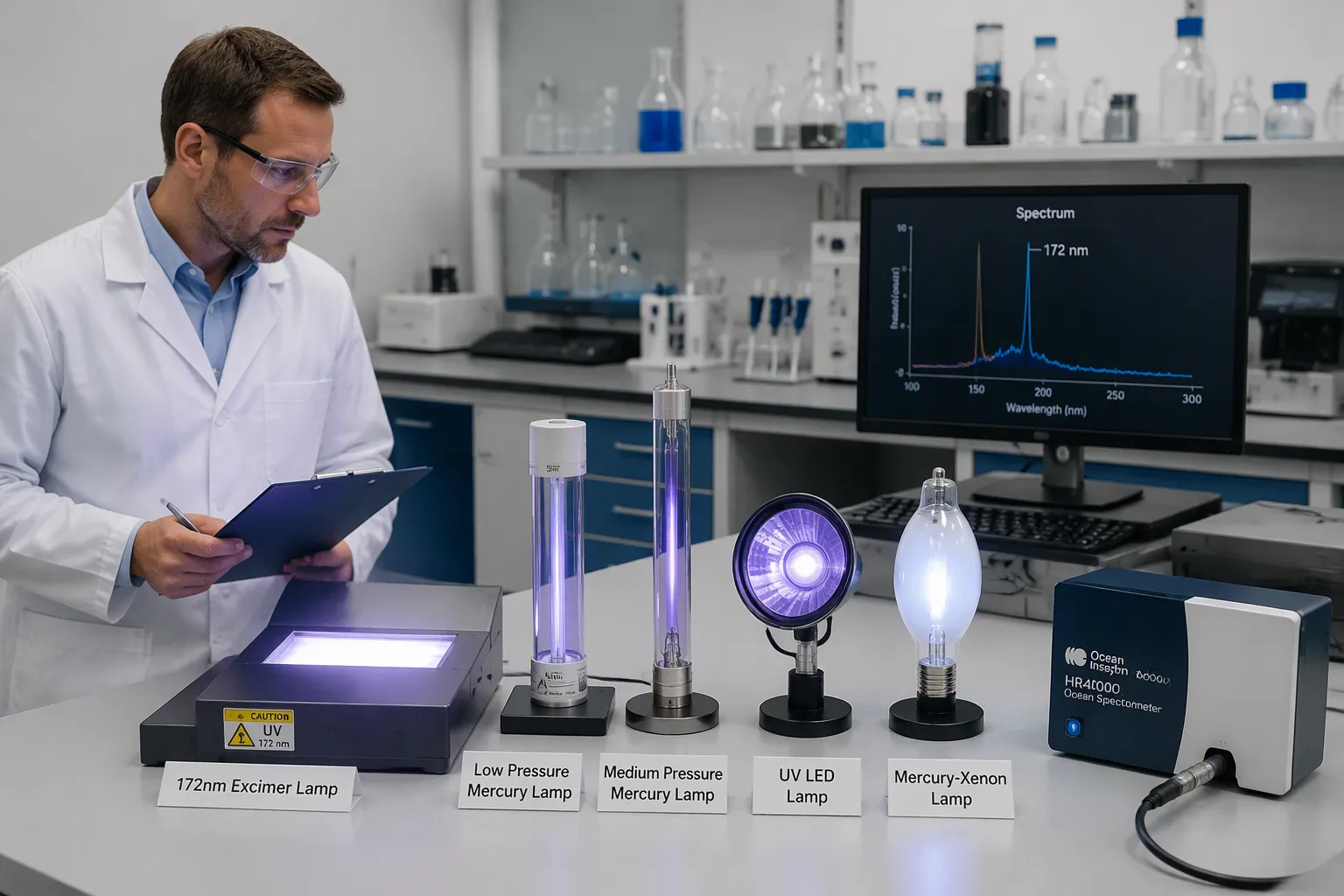
    A 172nm excimer lamp stands apart from mercury, LED, and other excimer lamps through its VUV output, high photon energy, instant on/off switching, mercury-free build, and shallow penetration. You will see how each option performs on technical specs, application fit, compliance, and cost. No single UV source wins everywhere; your process and regulations decide. GMY Lighting Technology Co., Ltd. supplies several excimer lamp types and offers this guide neutrally.   Key Takeaways A 172nm excimer lamp produces high-energy vacuum UV light. It starts instantly and contains no mercury. This lamp works well for surface curing and matting. It also generates ozone for air and water treatment. The lamp lasts over 8000 hours and uses about 30% less energy. It simplifies compliance and reduces maintenance.   172nm Excimer Lamp Specs Wavelength and Photon Energy A 172nm excimer lamp emits in the vacuum ultraviolet (VUV) band, a region with wavelengths shorter than 200 nm. You get a 172 nm excimer output from a xenon (Xe₂) excimer discharge. The photon energy reaches 7.2 eV, which is high enough for demanding material processing. Low-pressure mercury lamps emit at 185 nm and 254 nm, so their photons carry less energy. Medium-pressure mercury uv lamps spread output across a broader spectrum. Other sources of uv and vuv radiation each occupy their own niche. The short wavelength of this excimer lamp radiation drives photochemistry that longer-wavelength uv sources cannot match. The high photon energy matters for radical chemistry. A 172nm excimer lamp splits water and oxygen molecules directly at the surface. This step raises the quantum yield for hydroxyl radical (•OH) generation compared with low-pressure mercury lamps. High photon energy (7.2 eV): Rapidly generates highly reactive oxygen species (O(³P), O(¹D)) and various radicals. Benefits of Excimer Lamps The benefits of excimer lamps start with efficiency and stability. These devices switch on and off instantly, so you avoid warm-up delays. Output stays stable over the lamp's life. The construction explains much of this behavior. A noble-gas-filled, coated quartz chamber holds the discharge, and the coating protects the envelope from the aggressive vacuum uv environment. You also gain extended lamp life and fewer replacements. The table below summarizes the key photon energy figures. 172nm excimer lamp: 7.2 eV Low-pressure mercury lamp: lower photon energy at 185 nm and 254 nm Mercury lamps remain a mature, widely deployed option. They have decades of field history and broad availability. Excimer uv lamps simply offer a different trade-off: higher photon energy and instant control, with a narrower emission band. Your choice depends on the chemistry you need. For surface activation and thin-film work, the high energy of ultraviolet light from an excimer source often fits better. For bulk processes, established mercury-vapor lamps still serve well. Consider how each ultraviolet light source matches your process window before you commit.   Excimer Lamp Applications   Excimer Lamp Curing A 172nm excimer lamp deposits its energy in a very thin surface layer. Technical documentation on excimer lamp curing reports that 172 nm radiation polymerizes acrylate double bonds at the surface of a formulation layer, with only a limited depth of cure. The bulk beneath stays largely uncured. You can exploit this surface-dominant behavior. In printing and other photo-chemical processes, excimer lamp exposure produces a deep matting effect: the top layer crosslinks while the bulk remains soft. Formulators call this excimer matting, and it yields a deep matte coating with ultra-low gloss and no matting agents. The finish keeps ultra-low gloss after handling. Conventional matting uses fillers that scatter light; excimer lamp exposure achieves matting through chemistry. You get low gloss with a smooth hand. For wood panels and packaging, matting by this route creates low gloss surfaces that resist burnishing. Low gloss stays uniform across the panel. Low gloss depends on dose control, and low gloss repeatability improves with a stable lamp. Every matting step needs dose control, so matting quality tracks lamp stability. Matte surfaces show no glare, and surface gloss readings confirm the finish. A 172nm Excimer Photomodification Module combines lamp, power supply, and shielding for repeatable matting. Where you need a full cure through the film, pair surface matting with a deeper UV pass. A 172nm Excimer Module or a 172nm Excimer Lamp from GMY covers both roles.   Disinfection and Water Treatment A phosphor coating can shift the 172nm output to UVC for disinfection. In air and water treatment, vacuum ultraviolet light acts as a reducer and a disinfectant. Ozone forms readily at this wavelength; a 10W 172nm lamp produces ozone at 0.1 ppm per minute in a closed environment, which suits small-scale air purification. The table below shows where each option fits best. Lamp type Best fit 172nm excimer Surface treatment, ozone generation, compact air units Low-pressure mercury High-power municipal water disinfection UV LED Point-of-use disinfection, instant switching Other excimer lamps Narrow-band gas-phase chemistry Mercury lamps remain the workhorse for large water plants. LED sources suit low-power, frequent-start duties. Other excimer lamps serve niche gas-phase work. Each uv sources family has a clear fit, and uv-curable formulations respond best to the shorter vuv output.   UV Safety and Compliance Mercury-Free Operation A 172nm excimer lamp contains no mercury. You avoid the disposal rules, spill response plans, and end-of-life reporting that mercury-containing lamps trigger under hazardous waste regulations. This simplifies compliance for production lines and for water or air treatment installations. The mercury-free design also removes the risk of mercury contamination in food packaging, medical device, and electronics workflows. You can document a mercury-free process more easily during audits. The excimer lamp radiation itself still demands respect. Vacuum UV at this wavelength does not penetrate deeply, so shielding is straightforward. Enclose the lamp in a housing and interlock the access door. Operators then face no exposure during normal matting runs. A 172nm Excimer Module with integrated shielding keeps low gloss output repeatable while protecting staff. For matting lines, a 172nm Excimer Photomodification Module combines lamp, power supply, and enclosure in one unit.   Ozone and Operator Safety Ozone generation is the main safety consideration. At 172 nm, oxygen splits and recombines into ozone, and a 10W lamp can produce ozone at 0.1 ppm per minute in a closed space. You must ventilate or exhaust enclosed volumes. Install ozone monitors in work areas and set alarm thresholds. Route exhaust away from intake air. Excimer lamps switch off instantly, so you can stop uv output the moment a fault appears. This instant control supports safe matting and low gloss production. Train operators on lamp handling, because quartz envelopes are fragile. Replace damaged lamps before they affect matting quality or low gloss consistency. A documented safety routine protects both people and process.   Excimer Lamp Costs Purchase Price Upfront price varies widely across lamp families. A 172nm excimer lamp carries a higher initial cost than a standard low-pressure mercury tube, because the coated quartz chamber and noble-gas fill demand tighter manufacturing. Mercury-based lamps stay cheap to buy in volume. UV LED systems cost more at the module level, yet prices keep falling. Other excimer lamps sit in a similar range to xenon types. Treat purchase price as one line item, not the whole budget. A matting line that runs for years rarely wins on sticker price alone.   Operating and Maintenance Costs Lamp life drives the long-term math. The table below compares the two main options. Attribute Mercury-based lamps 172nm xenon excimer lamps Lifespan Typically 2000–4000 hours Over 8000 hours (case example: 9000 hours) Replacement frequency Higher Lower Energy/operating cost Baseline About 30% lower energy consumption Maintenance cost Higher due to short life Reduced via long-life design and easy-replace modules A longer service interval cuts downtime on a matting line. Fewer swaps also mean less labor and less risk of a damaged quartz envelope. Energy savings of roughly 30% compound across a production year. Modular, easy-to-replace components keep matting output steady between services. A 172nm Excimer Module simplifies that swap further. Specific price figures depend on your configuration, so request a quote rather than estimate. GMY Lighting Technology Co., Ltd. can help you match a lamp type to your application and budget, whether you run matting, curing, or disinfection.   A 172nm excimer lamp trades broad output for high photon energy, instant control, mercury-free compliance, and long life. Choose it for mercury-free surface curing and matting. Choose mercury for high-power water disinfection, LED for point-of-use uv, other excimer lamps for gas-phase work. For matting, matting lines, matting quality, matting consistency, matting output, matting runs, and matting budgets, GMY can match a lamp to your process.   FAQ These quick answers cover the questions readers raise most often, including how a 172nm Excimer Module fits a production line. What makes a 172nm excimer lamp different from a mercury lamp? It emits vacuum uv at 172 nm with 7.2 eV photons, switches instantly, and contains no mercury. Mercury tubes emit at 185 nm and 254 nm with lower photon energy. Can I use a 172nm excimer lamp for disinfection? Yes. A phosphor coating shifts the uv output to UVC. Add shielding and dose control for air or water treatment, and monitor uv exposure. How do I control ozone during operation? Ventilate enclosed spaces and install ozone monitors. A 10W lamp produces ozone at 0.1 ppm per minute in a closed environment. Route uv exhaust away from intake air.
  • 172nm Excimer Lamps – From Surface Cleaning to Nanofabrication
    172nm Excimer Lamps – From Surface Cleaning to Nanofabrication
    Oct 16, 2026
    Dirty surfaces ruin adhesion and precision. A 172nm excimer lamp solves this with vacuum ultraviolet light. These excimer lamps break organic bonds and clean without chemicals. They also support nanofabrication. Engineers value dry processing, high precision, and mercury-free operation. This journey spans surface cleaning to advanced nanofabrication.   What Is a 172nm Excimer Lamp? A 172nm excimer lamp is a cold, quasi-monochromatic vacuum ultraviolet (VUV) light source. It emits a narrow band of light centered at 172nm. Engineers use these lamps for cleaning, activation, and lithographic work.   How a 172nm Excimer Lamp Works The lamp contains high-purity inert xenon gas sealed between two electrodes. At least one electrode sits behind a dielectric layer. A high-voltage alternating current drives a dielectric barrier discharge through the gas. This discharge creates short-lived xenon excimer molecules, which release energy as photons. The emission peaks at 172nm. The process runs cool, so the lamp does not rely on a hot filament. A mercury-free xenon design also avoids toxic fill materials. The physics behind how a 172nm excimer lamp works is straightforward. Each photon carries enough energy to break chemical bonds directly. Oxygen molecules absorb this light strongly, so the beam does not travel far through air. That short absorption depth concentrates the reaction near the lamp and the target surface.   Why the 172nm Wavelength Matters The 172 nm wavelength sits deep in the vacuum ultraviolet region. Air absorbs it within a short distance, which limits beam travel but creates a dense cloud of reactive species. Oxygen splits into atomic oxygen when it absorbs these photons. Atomic oxygen then combines with molecular oxygen to form ozone. Both species attack organic contamination on nearby surfaces. This behavior gives the 172nm mercury-free uv lamp two core advantages. First, the narrow-band output delivers energy at one useful wavelength instead of spreading it across the spectrum. Second, the mercury-free construction removes a hazardous material from the process line. A xenon excimer lamp therefore suits cleanrooms, food packaging, and medical device manufacturing. The narrow bandwidth also makes the output predictable. Engineers can calculate dose from lamp power and exposure time. They do not need to filter out unwanted wavelengths. This predictability supports repeatable surface preparation across production runs. Excimer lamps differ from conventional mercury lamps in one more way. They switch on instantly and reach full output without a warm-up period. That instant-on behavior reduces cycle time in automated lines. It also allows pulsed operation for dose-sensitive processes. In short, the lamp is a gas-discharge device that converts electrical energy into VUV photons. Those photons drive photochemical reactions rather than heat. The next section explains how those reactions produce ozone and activate surfaces.   The 172nm Vacuum Ultraviolet Light Source A 172nm vacuum ultraviolet light source generates photons with enough energy to break molecular bonds. Oxygen molecules absorb these photons and split into single oxygen atoms. This reaction happens fast and needs no catalyst.   Ozone Production with Excimer Lamps, 172 nm Ozone production with excimer lamps, 172 nm follows a simple two-step path. A VUV photon strikes an oxygen molecule and splits it into two oxygen atoms. Each free atom then collides with another oxygen molecule and forms ozone. This cycle repeats as long as the lamp runs. The 172nm output drives this process efficiently. Air absorbs the light within a short distance, so ozone generation stays close to the lamp and the target surface. Workers must ventilate the process area because ozone irritates the lungs. A sealed chamber or exhaust system controls the concentration.   Reactive Oxygen Species and Surface Activation Excimer lamps for surface activation, 172 nm create a mix of reactive oxygen species. Atomic oxygen and ozone both attack organic molecules on a surface. They break carbon-hydrogen and carbon-carbon bonds and convert contaminants into volatile compounds like carbon dioxide and water. The surface then releases these gases. This chemistry raises surface energy on many materials. Glass, metals, and polymers all respond to this treatment. Water spreads evenly across a treated polymer instead of beading up. That wettability change proves the surface activation worked. Adhesives, coatings, and inks then bond more strongly. The reaction also stays dry and chemical-free. No solvents touch the part. No rinse step follows. Manufacturers value this because it cuts waste and avoids damage to heat-sensitive substrates. A vacuum ultraviolet (vuv) light source therefore handles delicate polymers that wet chemistry would ruin.   Surface Cleaning with 172nm Light   The Photochemical Cleaning Mechanism A 172nm excimer lamp cleans surfaces through a photochemical reaction rather than heat or abrasion. The lamp emits photons that carry enough energy to break chemical bonds directly. Oxygen in the surrounding air absorbs this light and splits into atomic oxygen. Those atoms then form ozone, which acts as a strong oxidizing agent. Organic contaminants consist mainly of carbon-hydrogen and carbon-carbon bonds. The VUV photons and reactive oxygen species attack these bonds at the surface. The bonds break apart, and the carbon converts into volatile compounds such as carbon dioxide and water vapor. These gases leave the surface on their own. No residue remains behind. This mechanism drives organic contamination removal on glass, metals, ceramics, and polymers. The reaction happens only where the light reaches, so masked areas stay untreated. That selectivity gives engineers precise control over which regions become clean. The same chemistry supports semiconductor wafer and mask organic particle removal, where even trace residues ruin device performance. A single 172nm excimer lamp can treat a full wafer surface in one exposure step.   Advantages Over Wet and Plasma Cleaning Wet chemical cleaning relies on solvents, acids, and rinses. Those liquids create waste streams, require drying steps, and can damage heat-sensitive or moisture-sensitive parts. Plasma cleaning works well but needs vacuum chambers and can cause charging damage on delicate devices. Excimer lamps avoid both problems.   Method Solvents Temperature Substrate Damage Risk Wet chemical Yes Moderate to high Etching, swelling, residue Plasma No Low Charging, ion bombardment 172nm dry cleaning No Low Minimal The dry process needs no rinse and no drying cycle. It runs at low temperature, so polymers and thin films keep their shape. The treatment also raises surface energy, which improves adhesion for later coating or bonding steps. This surface activation happens in the same pass as the cleaning. Excimer lamps offer another practical benefit. They switch on instantly and need no warm-up. Production lines therefore avoid idle time between batches. The mercury-free design also removes a toxic material from the workspace. For manufacturers weighing cost, waste, and part quality, the dry route wins on all three counts.   Excimer Lamp Application Uses in Industry   Printing, Matte Finishing, and Curing Manufacturers have relied on excimer lamps for decades in printing and coating lines. A 172nm lamp cures specialized inks and coatings without heat. This cold process protects paper, foil, and thin polymer films that would warp in a thermal oven. The same light source creates a matte finish on surfaces without mattifying agents. Traditional matte additives scatter light and weaken the coating. The 172nm treatment instead modifies the surface texture directly, so the finish stays durable and clean. These key applications and advantages explain the wide adoption of excimer lamps in packaging and label production. The lamp switches on instantly, which keeps high-speed lines moving. No solvents evaporate during curing, so the workplace stays safer. Printers also avoid the powder dust that conventional matte processes leave behind.   Water Purification and Air Disinfection Environmental engineers use excimer lamps for water purification and air treatment. The 172nm output drives a photochemical reaction that breaks down organic pollutants in effluent. Ozone forms near the lamp and oxidizes contaminants that resist other methods. This approach treats industrial wastewater without adding chlorine or other harsh chemicals. Air disinfection follows a similar path. The lamp destroys bacteria, viruses, and mold spores in ventilation ducts and enclosed rooms. Unlike uvc disinfection with mercury tubes, a xenon excimer lamp contains no toxic mercury. That difference matters for food processing plants and hospitals. Disinfection applications also extend to surface sterilization on packaging lines. The dry, chemical-free nature of these disinfection processes suits sensitive environments where residue would cause problems.   Nanofabrication and Advanced Applications   Photolithography and Surface Patterning Excimer lamps enable high-precision photochemical modification at the nanoscale. The 172nm output carries enough photon energy to drive reactions in resist materials and self-assembled monolayers. Engineers expose a masked substrate to the lamp, and the light alters only the unmasked regions. This selective exposure creates patterns with sharp edges. The short absorption depth of 172nm light keeps the reaction confined near the surface, which prevents blurring from scattered light. This capability supports damage-free precision processing on delicate substrates. Conventional lithography often relies on electron beams or deep ultraviolet lasers. Those tools can charge or heat the sample. A 172nm excimer lamp instead works through photons alone, so the substrate stays cool and uncharged. Manufacturers use this approach for patterning organic films, modifying polymer surfaces, and preparing templates for further deposition.   Thin-Film Processing and Surface Modification Excimer lamps also serve thin-film processing and surface modification. The reactive oxygen species generated by the lamp oxidize thin metal films or remove organic residues from film surfaces. This oxidation happens at low temperature, so the underlying layers keep their properties. Engineers can tune the exposure dose to control oxide thickness or to strip a sacrificial layer without attacking the functional film beneath it. Surface activation plays a central role in these steps. A brief exposure raises the surface energy of a film, which improves adhesion for the next deposited layer. Excimer lamps therefore fit into multi-step fabrication flows where each layer must bond cleanly to the one below. The dry, chemical-free nature of the process also avoids solvent residues that would contaminate a vacuum chamber. For nanoscale devices, this level of control matters because a single stray particle can ruin the final structure.   Safety, System Design, and Future Outlook   Handling UV Radiation and Ozone Byproducts Operators must treat 172 nm excimer lamps with the same caution as any intense UV source. Direct exposure harms eyes and skin, so enclosures and interlock switches protect workers. Personal protective equipment adds another layer when maintenance requires open access. Engineers also design shielding that blocks stray light from reaching adjacent workstations. Ozone ventilation remains equally important. The 172nm output splits oxygen into atomic oxygen, which then forms ozone near the lamp. This gas irritates the lungs at low concentrations. A sealed chamber with exhaust airflow keeps ozone levels safe. Sensors can monitor the workspace and trigger alarms if concentrations rise. Proper ventilation design therefore protects both equipment and personnel.   Lamp Lifetime, Efficiency, and Market Trends Lamp lifetime varies with power level and duty cycle. Higher drive power shortens service life, so system designers balance output against replacement intervals. Output also fluctuates as the lamp ages. Engineers compensate by adjusting exposure time or lamp current to maintain a consistent dose. Compared with 222nm and 308nm alternatives, 172 nm lamps offer stronger bond-breaking energy. The 222nm option penetrates tissue less deeply, which suits disinfection applications where safety margins matter. The 308nm wavelength carries less photon energy and serves different photochemical needs. Each wavelength fills a distinct role. Market trends favor mercury-free sources for disinfection and surface activation. Efficiency improvements continue to extend lamp life and reduce operating costs. Manufacturers increasingly adopt excimer lamps for applications that demand dry, chemical-free processing. This shift supports cleaner production lines across many industries.   A 172nm excimer lamp bridges routine cleaning and nanofabrication. These excimer lamps deliver dry, chemical-free processing with high precision. They run mercury-free and serve many industries. Adoption grows as efficiency improves. Excimer lamps now support disinfection and emerging nanoscale work. Engineers evaluating this 172nm technology should pilot it on their toughest contamination problem first.   FAQ How does a 172nm excimer lamp remove contamination? The lamp emits vacuum ultraviolet photons. These photons break organic bonds on the surface. Oxygen absorbs the light and forms reactive species. These species convert contaminants into carbon dioxide and water vapor. The surface releases these gases. Do operators need special safety measures? Yes. Direct UV exposure harms eyes and skin. Enclosures and interlocks protect workers. Ozone forms near the lamp, so exhaust ventilation keeps levels safe. Sensors monitor the workspace. Proper shielding blocks stray light. Where do excimer lamps support disinfection? Water treatment plants use them to break down organic pollutants. Air disinfection systems destroy bacteria and viruses in ducts. Surface disinfection on packaging lines also relies on these lamps. The mercury-free design suits hospitals and food processing. Disinfection works without harsh chemicals.
  • How to choose a 172nm excimer lamp for industrial use
    How to choose a 172nm excimer lamp for industrial use
    Sep 16, 2026
    You need a solid grasp of the broader EV charging ecosystem before you select a 172nm excimer lamp for industrial use. These lamps serve as critical components in advanced charging station manufacturing and maintenance. An excimer lamp delivers the precision surface treatment that keeps ev chargers dependable. EV chargers supply electric power to replenish electric vehicle batteries. EV charging reliability depends on precision parts. This guide explains EV charging and charger selection for industrial charging applications. You will learn to match each charger to demanding charging environments.   Key Takeaways A 172nm excimer lamp makes EV chargers more reliable by treating capacitor films with UV light. Choose a lamp with stable wavelength, high intensity, and good uniformity for industrial EV charging production. Water cooling extends lamp operation to 24 hours, which supports round-the-clock manufacturing of EV charging components.   How Does It Work: EV Chargers and EV Charging   The basics of EV charging An EV charger is a device that converts grid electricity into the correct voltage and current for an electric vehicle battery. You will encounter two main charging types: AC charging and DC fast charging. AC charging relies on the vehicle's onboard charger to convert alternating current to direct current inside the car. The charging station itself remains simple and passes AC power to the vehicle. DC fast charging bypasses the onboard charger entirely. The station converts AC to DC and sends power directly to the battery, which enables much faster charging speeds. Charging speed varies by level. Level 1 adds 3-5 miles of range per hour. A 50A Level 2 charger adds up to 37 miles per hour. One manufacturer states its 240-volt Level 2 home charger delivers up to 50 amps and adds up to 37 miles of range per hour. Commercial Level 2 stations typically use 208V input and provide approximately 6.2 to 19.2 kW of power. The vehicle's onboard charger limits charging speed. A vehicle with a 7 kW maximum will not charge faster even on a 19.2 kW Level 2 charger.   From grid power to battery energy Grid electricity is alternating current. An EV battery stores direct current. The conversion from AC to DC must happen somewhere. In AC charging, the vehicle's onboard system handles this power conversion. In DC fast charging, the station performs the conversion. This difference explains why DC fast charging delivers much higher voltage and current. The station uses larger, better-cooled equipment that produces significantly higher kW and faster charging. Energy loss occurs during this transfer. When 10 kWh is drawn from the grid but only 9 kWh reaches the battery, the charging loss amounts to 10%. Typical Level 2 home chargers achieve 83-94% grid-to-battery efficiency. A 50 kW charger at 77°F exceeds 90% efficiency, but the same charger at -13°F drops below 40%. The 172nm excimer lamp plays a critical role in manufacturing EV charging equipment. A research team used 172nm and 222nm excimer UV lamps to irradiate BOPP capacitor films. This UV irradiation nearly doubled the energy discharge density of the capacitor films and increased high-temperature short-burst performance by up to 52%. BOPP film capacitors are essential in electric vehicles for efficient energy transfer and short bursts of increased power. The 172nm excimer lamp process directly addresses the high-temperature performance bottleneck that constrains EV applications. This single-step, high-throughput method can extend to other high-temperature dielectric films.   Choosing a 172nm excimer lamp for EV charging systems   Key specifications for industrial EV use Industrial EV charging infrastructure demands durable, high-performance components. You cannot treat a 172nm excimer lamp as a generic part. Each specification affects how well your ev chargers perform over years of continuous operation. Wavelength stability tops your priority list. The lamp must hold its 172nm output without drift. Any shift reduces the surface treatment quality on capacitor films and other critical components. Intensity determines process speed. Higher intensity means faster treatment, which matters when you produce ev charging equipment at scale. Uniformity ensures every square centimeter of your substrate receives identical treatment. Poor uniformity creates weak points in the finished charger. Lifetime directly impacts your maintenance schedule. A short-lived lamp forces frequent replacements and production stops. Cooling requirements demand careful planning. For high-throughput production lines, water cooling systems can be integrated to extend continuous operation of 172nm excimer lamps to 24 hours. For high-throughput production lines, water cooling systems can be integrated to extend continuous operation of 172nm excimer lamps to 24 hours. This capability supports round-the-clock manufacturing of ev charging components.   Matching the lamp to EV charging applications You must match the industrial 172nm excimer lamp to your specific application. A 172nm Excimer Lamp Module designed for laboratory use will fail in a factory environment. GMY provides excimer lamps designed for industrial reliability in ev charging manufacturing. Their products address the demanding conditions of continuous production. Total cost of ownership extends beyond purchase price. You must calculate lamp replacement frequency, downtime costs, and energy consumption. A cheaper excimer lamp that fails every few months costs more than a premium lamp that runs for years. Maintenance access matters too. Can your technicians replace the lamp without disassembling the entire charging station? Integration with existing ev charging station designs requires careful planning. The lamp module must fit your production line without major modifications. The right 172nm excimer lamp ensures consistent performance and safety in ev charging equipment. A public charger that fails because of poor capacitor film quality damages your reputation. Public charging stations depend on reliable components. Whether you build AC chargers or dc fast charging equipment, the electric vehicle industry expects dependable products. Your ev charging business grows when your chargers perform flawlessly. Every charging session reflects the quality of your manufacturing. A charger built with precision components keeps customers returning. The ev market rewards manufacturers who prioritize quality. Your charging infrastructure investment pays off when you select the right excimer lamp from the start.   You now understand how ev chargers work and how ev charging delivers power to the battery. That knowledge guides your 172nm excimer lamp choice. Industrial buyers must weigh technical specifications, application fit, and total cost of ownership. A 172nm excimer lamp from GMY supports reliable ev charging infrastructure, whether you build a public charger, a charging station, or dc fast charging equipment for every electric vehicle. Consult GMY today. Your excimer lamp decision shapes public charging stations and each ev charger you ship.   FAQ What wavelength does a 172nm excimer lamp emit? It emits at 172nm. This wavelength supports ev equipment production. Each ev charger benefits from precise surface treatment. Every ev part matters. Why does cooling matter for an industrial 172nm excimer lamp? Water cooling extends continuous operation to 24 hours. This helps you build ev chargers without stops. Every ev charging line needs a stable charger design. How does lamp lifetime affect ev charger manufacturing? A short-lived excimer lamp forces frequent replacements. That downtime raises costs for each ev charger. Choose a durable 172nm Excimer Lamp Module for ev charging production.
  • Precision Surface Engineering with 172nm Excimer Lamps: Principles, Industrial Use, and Buyer’s Guide
    Precision Surface Engineering with 172nm Excimer Lamps: Principles, Industrial Use, and Buyer’s Guide
    Sep 09, 2026
    Modern industrial manufacturing demands higher precision, lower thermal budgets, and environmentally sustainable processing techniques. As microelectronics shrink, optical displays become more flexible, and medical devices require stricter biocompatibility, conventional wet chemical etching and high-heat thermal treatments often fall short.   The 172nm excimer lamp has emerged as a critical vacuum ultraviolet (VUV) light source across advanced manufacturing. By operating at a quasi-monochromatic wavelength of 172 nanometers, these lamps deliver high-energy photons capable of breaking molecular bonds directly without thermal degradation. 1. Operating Principles of the 172nm Excimer Lamp To understand why a 172nm excimer lamp delivers such consistent results across sensitive substrates, it is essential to evaluate its underlying physics: dielectric barrier discharge (DBD) and high-energy photon generation.   Dielectric Barrier Discharge and Xenon Chemistry Unlike conventional medium-pressure or low-pressure mercury discharge lamps, excimer (excited dimer) lamps do not use an electrode arc in direct contact with the gas mixture. Instead, they rely on a dielectric barrier—typically high-purity synthetic quartz—separating the discharge electrodes from a rare gas filling.   Inside a 172nm excimer lamp, the chamber is filled with pure xenon gas (Xe). When an alternating high-voltage, high-frequency electrical field is applied across the dielectric barrier, a non-equilibrium cold plasma forms. Xenon atoms are excited and collide with neutral ground-state xenon atoms to create transient excimer molecules (Xe₂*):   Xe* + Xe + M → Xe₂* + M   Because the ground state of an excimer molecule is weakly repulsive, the molecule rapidly dissociates (within nanoseconds), releasing a photon at a narrow spectral peak centered precisely at 172 nm:   Xe₂* → 2Xe + hν (172 nm)   The Energy Advantage of Vacuum Ultraviolet Photons A wavelength of 172 nm falls squarely within the vacuum ultraviolet spectrum. The energy carried by a single photon is inversely proportional to its wavelength, calculated by the Planck-Einstein relation:   E = hc / λ ≈ 7.2 eV   A single 172 nm photon delivers approximately 7.2 electron volts (eV) of energy (roughly 696 kJ/mol). This exceeds the binding energies of most covalent chemical bonds found in organic matter and industrial polymers: Carbon-Hydrogen (C-H): ≈ 4.3 eV (413 kJ/mol) Carbon-Carbon (C-C): ≈ 3.6 eV (347 kJ/mol) Carbon-Oxygen (C-O): ≈ 3.7 eV (358 kJ/mol) Silicon-Carbon (Si-C): ≈ 3.3 eV (318 kJ/mol) Because the photon energy exceeds these dissociation thresholds, the 172nm excimer lamp initiates direct photolysis. Substrate bonds break instantaneously without requiring the material to absorb thermal energy, making it an ideal "cold" process. 2. Core Mechanisms: Photolysis and Reactive Oxygen Species The processing power of a 172nm excimer lamp relies on two concurrent actions: direct molecular bond breaking and the simultaneous generation of aggressive reactive species.   172nm VUV Photons (7.2 eV) / \ / \ Direct Bond Cleavage Ambient Oxygen Absorption (C-C, C-H, C-O break) (O₂ + hν → O(¹D) + O(³P)) \ / \ / Active Radical Sites ↓ Functional Hydrophilic Layer (-OH, -COOH, -CHO groups)   Direct Photolysis of Contaminants: Trace organic residues, processing oils, photoresist leftovers, and release agents on the substrate absorb 172nm radiation strongly. The VUV photons snap the polymer backbone, converting heavy macromolecules into smaller volatile fragments. Singlet Oxygen and Ozone Generation: In the presence of ambient or controlled oxygen (O₂), 172nm photons are intensely absorbed. This breaks the molecular oxygen bond to yield ground-state atomic oxygen (O(³P)) and excited-state singlet oxygen (O(¹D)). These radicals react with oxygen to form ozone (O₃). Oxidative Desorption: The atomic oxygen and ozone react with the cleaved hydrocarbon fragments, oxidizing them into benign, volatile byproducts such as carbon dioxide (CO₂), water vapor (H₂O), and trace nitrogen oxides (NOₓ), which are swept away by local exhaust ventilation. Surface Functionalization: On clean base materials (such as polyimide, PET, or glass), the broken bonds leave free surface radicals. These instantly bond with oxygen and ambient moisture to create polar, hydrophilic functional groups such as hydroxyl (-OH), carboxyl (-COOH), and carbonyl (-C=O). This drastically reduces the water contact angle and elevates surface free energy. 3. Key Industrial Applications The combination of dry photochemical cleaning, a zero-mercury footprint, and low process temperatures makes the 172nm excimer lamp essential across several high-precision sectors.   Industry Primary Functional Role Semiconductor & Wafers Atomic-scale residue stripping, organic degassing, pre-bond Flat Panel Displays Polyimide cleaning, micro-LED wettability, anti-glare cure Precision Optics Non-contact optical substrate de-oiling, coating prep Medical Polymers Microfluidic bonding, hydrophilic catheter functionalization Industrial Coatings Ultra-matte excimer curing, scratch-resistant texturing   Semiconductor and Advanced Packaging In wafer processing, wire bonding, and wafer-to-wafer direct bonding, atomic-scale interface cleanliness dictates final yield. Residues left behind by chemical-mechanical planarization (CMP) slurries or organic solvents compromise bond strength and introduce structural voids.   Using a 172nm excimer lamp allows fabs to clean silicon wafers, silicon carbide (SiC), and gallium nitride (GaN) wafers without the physical abrasion of scrubbers or the environmental hazards of wet solvent benches.   Flat Panel Displays and Flexible Electronics Display manufacturing—including OLED, QLED, and micro-LED lines—relies on ultra-clean thin-film transistors (TFTs) and uniform surface tension across large glass and polyimide sheets. A 172nm system increases surface wettability, enabling optical adhesives, coatings, and inkjet-printed quantum dots to wet out uniformly without pinholes or edge dewetting. Because the process generates virtually zero radiant infrared heat, ultra-thin polymer substrates (such as 10 μm to 25 μm polyimide films) remain mechanically stable without curling or warping. Industrial Coatings and Excimer Matting In high-end automotive interior trim, architectural flooring, and specialty foils, manufacturers often require deep-matte, soft-touch, yet scratch-resistant finishes. When applied to specialized UV-curable acrylate coatings, the shallow penetration depth of 172nm VUV light initiates rapid polymerization of only the top few tens of nanometers of the wet resin. This microscopic top skin shrinks and micro-folds while the underlying resin remains fluid. Subsequent exposure to longer-wavelength UV sources (such as 365nm or 395nm UV LEDs) cures the bulk layer beneath, locking the micro-folded texture in place. This delivers a uniform physical matting effect without requiring chemical silica matting agents, yielding superior anti-fingerprint and scratch-resistant properties. Medical Device Manufacturing Medical components such as catheters, microfluidic chips, and diagnostic cassettes frequently utilize inert engineering plastics (like cyclic olefin copolymers, PEEK, or PTFE). These plastics have low surface energy, making them difficult to print, coat, or bond with medical-grade adhesives.   VUV treatment with a 172nm excimer lamp functionalizes these inert plastics rapidly, yielding robust hydrophilic properties that pass stringent peel tests and maintain bond integrity without introducing toxic chemical primers. 4. Comparing 172nm Excimer Technology to Alternative Methods Engineers evaluating surface treatment techniques often balance excimer technology against traditional low-pressure mercury lamps, atmospheric plasma, and corona discharge.   Parameter 172nm Excimer Lamp Low-Pressure Hg UV Atmospheric Plasma Primary Mechanism VUV Photolysis Photochemical / O₃ Ion Bombardment Dominant Wavelength 172 nm (Quasi-mono) 185 nm / 254 nm Broad / Thermal RF Thermal Load Extremely low Moderate to High Moderate Surface Uniformity Exceptionally high High Variable / Jet-dep Mercury Content 100% Mercury-Free Contains Mercury Mercury-Free Warm-Up Time Instant on/off 3 to 10 minutes Instant Substrate Damage Zero static/charge None Potential ESD risk   172nm Excimer vs. Low-Pressure Mercury Lamps Low-pressure mercury lamps emit primarily at 254 nm and 185 nm. While the 185 nm line generates ozone, its photon energy (6.7 eV) is lower than that of 172 nm (7.2 eV), leading to significantly slower bond-cleavage rates on refractory organics.   Furthermore, mercury lamps emit considerable infrared heat and broad-spectrum energy, raising substrate temperatures. Mercury lamps also require long warm-up and restrike cycles, whereas dielectric barrier discharge excimer lamps turn on and off instantly.   From an environmental and regulatory standpoint, global initiatives such as the Minamata Convention on Mercury continue to restrict mercury usage, driving manufacturers toward mercury-free excimer configurations.   172nm Excimer vs. Atmospheric Plasma and Corona Atmospheric plasma and corona discharge treat surfaces via accelerated ions, electrons, and reactive gas jets. While cost-effective for coarse packaging films, plasma and corona methods exhibit limitations on delicate parts: Micro-Arcing and ESD: Plasma poses an electrostatic discharge (ESD) risk to sensitive microelectronics, integrated circuits, and active TFT layers. A 172nm excimer lamp works strictly through non-ionizing optical radiation, eliminating electrical charge accumulation. Surface Pitting: The kinetic impact of ions in atmospheric plasma torches can physically erode or pit ultra-smooth optical surfaces. 172nm photolysis leaves the underlying physical morphology completely unaltered down to sub-nanometer roughness. Uniformity over Wide Areas: Corona and plasma jets suffer from uneven nozzle wear and aerodynamic boundary layer variations across wide webs. Excimer tubular lamps deliver uniform photon flux across broad substrate widths. 5. Engineering and Integration Guide for B2B Buyers Integrating a 172nm excimer lamp into an automated roll-to-roll line, cleanroom conveyor, or indexing station requires careful attention to optical path mechanics, thermal management, and safety protocols.   Controlling the Process Atmosphere (Nitrogen Purging) Atmospheric air contains approximately 21% molecular oxygen. Because 172nm photons are strongly absorbed by oxygen, VUV light attenuates over short travel distances in standard air:   Transmission: I = I₀ × e^(-αpx)   To prevent premature photon loss before the light strikes the target substrate, the optical path must be enclosed and purged with high-purity industrial nitrogen (N₂). Maintaining an oxygen concentration between 10 ppm and 500 ppm in the working gap allows maximum VUV energy to strike the substrate while retaining just enough trace oxygen to produce functional singlet oxygen. The gap distance between the lamp quartz face and the substrate is typically engineered between 1 mm and 5 mm to minimize purge volume and maximize photon flux. Lamp Geometries and Integration Depending on the production format, industrial excimer systems utilize distinct physical configurations: Linear Tubular Lamps: These provide continuous, uniform exposure zones across web widths spanning from 100 mm to over 2,000 mm, making them standard for roll-to-roll film lines, wide glass cleaning, and continuous sheet lines. Flat Panel/Planar Configurations: Planar excimer configurations provide wide, uniform two-dimensional irradiation for static chamber batch processing, wafer chucks, and microfluidic plate bonding. Thermal Dissipation and Power Supply Matching Although excimer discharge is inherently cold, the electrical efficiency of VUV generation results in a portion of input power converting into ambient quartz heating. System builders must match the excimer lamp with a dedicated high-frequency, high-voltage resonant inverter power supply. Controlled cooling—via filtered laminar nitrogen flow, dry clean air (CDA) shrouds, or integrated water-cooled electrode blocks—ensures stable operating temperatures and protects the quartz dielectric seal, extending lamp life beyond 3,000 to 5,000 operating hours. 6. Sourcing Industrial Optical Solutions from GMY Selecting the right light source requires pairing component specifications with production line mechanics. Industrial sourcing teams must verify electrical matching, spectral emission purity, and quartz material standards to avoid mid-run process variations.   For technical teams seeking reliable VUV integration, GMY develops professional lighting and industrial optical solutions engineered to rigorous industrial tolerances. GMY provides comprehensive design support, helping systems integrators and factory managers deploy lighting configurations that match their exact dimensional constraints and throughput targets.   By visiting www.gmyok.com, process engineers and procurement specialists can access detailed product data, explore industrial lighting portfolios, and discuss specialized OEM/ODM manufacturing requirements directly with technical experts. Frequently Asked Questions (FAQ) What is the typical service life of an industrial 172nm excimer lamp? Industrial 172nm excimer lamps typically offer an operating lifespan between 3,000 and 5,000 hours, depending on operating duty cycles, electrical frequency matching, and thermal management. Because there are no internal metal filaments or electrodes to sputter onto the quartz envelope, excimer lamps deliver superior lumen maintenance and slower output decay compared to mercury arc lamps.   Why is nitrogen purging necessary when operating a 172nm excimer lamp? Photons at 172 nm are readily absorbed by standard atmospheric oxygen. If operated in ambient room air, the VUV energy is completely absorbed within a few millimeters, converting the oxygen to ozone without reaching the target surface. Purging the chamber with industrial nitrogen allows the VUV photons to travel efficiently to the substrate while precisely metering the reactive species generated at the boundary layer.   Does 172nm treatment damage delicate thin films or transparent conductive oxides (TCO)? Because 172nm treatment relies on photochemical bond cleavage rather than physical ion bombardment or intense heat, it preserves the physical topography and bulk crystalline properties of the material. When calibrated to the appropriate line speed and dosage, it cleans and functionalizes transparent conductive layers (such as ITO or silver nanowires) without causing optical hazing, thermal deformation, or resistivity spikes.   How do operators manage ozone generated during 172nm excimer operation? Any exhaust containing residual ozone from the process chamber must be routed through a dedicated industrial ozone decomposer. These systems typically utilize thermal destruct units or manganese dioxide/copper oxide catalytic filters to safely break ozone (O₃) back down into standard molecular oxygen (O₂) prior to facility exhaust discharge. Advance Your Precision Surface Treatment Line Whether retrofitting an existing display production line, enhancing wafer-bonding adhesion, or developing next-generation ultra-matte industrial coatings, incorporating a high-performance 172nm excimer lamp provides non-destructive, mercury-free, cold-surface processing.   Visit GMY today to explore industrial light source configurations, request technical specifications, and connect with optical engineers ready to support your manufacturing goals.   Explore GMY 172nm Excimer Lamp Solutions
  • A New Standard for Dry Cleaning and Surface Activation in Advanced Manufacturing
    Sep 04, 2026
    In advanced manufacturing industries such as semiconductors, display panels, precision optics, and microelectronics, surface cleanliness can directly influence product quality, process stability, and final manufacturing yield.   Traditional wet cleaning methods often rely on chemicals and solvents. While they can effectively remove contaminants, they may also leave chemical residues and introduce additional cleaning, rinsing, and drying processes. For sensitive and high-precision components, conventional cleaning methods may also create concerns about material damage.   Today, a new dry surface treatment technology based on 172nm excimer light is providing manufacturers with another solution. With its high-energy vacuum ultraviolet radiation and non-contact processing characteristics, 172nm Excimer Lamp technology can remove organic contamination while simultaneously activating the material surface, offering a cleaner and more efficient approach for precision surface treatment. The Technology Behind It: How Does 172nm Excimer Light Clean and Activate Surfaces? The 172nm wavelength belongs to the vacuum ultraviolet (VUV) range and provides high-energy photons capable of initiating powerful photochemical reactions. When 172nm VUV radiation reaches organic contaminants on a material surface, the high-energy photons can break molecular bonds and decompose organic compounds.   At the same time, in the presence of oxygen, VUV irradiation promotes the formation of reactive oxygen species that further oxidize and decompose organic residues.This creates a highly effective combination of photolysis and photo-oxidation.The result is a contactless dry-cleaning process that can remove organic contamination from precision surfaces without relying on conventional liquid cleaning agents.   Photochemical Cleaning: Removing Organic Contaminants The high-energy radiation of a 172nm Excimer Lamp can break down hydrocarbon chains, oil residues, organic contaminants, and other surface impurities.Reactive oxygen species then further oxidize these decomposed compounds, converting organic residues into simpler substances such as CO₂ and H₂O.   This makes 172nm VUV technology particularly suitable for removing microscopic organic contamination before critical manufacturing processes.Unlike mechanical cleaning, the process does not require direct physical contact with the substrate. Compared with conventional wet cleaning, it can also reduce dependence on chemical cleaning agents.   Surface Activation: Improving Hydrophilicity Cleaning is only one part of the process. The photochemical reaction generated by 172nm excimer light can also modify the chemical characteristics of the material surface. For non-polar materials, VUV irradiation can break hydrocarbon molecular chains and introduce polar hydrophilic groups such as hydroxyl (-OH) and carboxyl (-COOH) groups.   This increases the surface free energy and improves wettability. In practical applications, a surface that was originally hydrophobic can become significantly more hydrophilic after 172nm treatment, creating a better interface for subsequent coating, bonding, printing, and other processes. The Visible Result: Water Contact Angle Reveals Surface Activation Water contact angle is one of the most intuitive ways to evaluate surface wettability and surface condition. Before treatment, organic contamination or the naturally low surface energy of certain materials can cause a water droplet to remain rounded on the surface, resulting in a relatively large contact angle.   After treatment with a 172nm Excimer Lamp, the surface can become more hydrophilic, allowing the water droplet to spread across the substrate more easily. Instead of remaining as a spherical droplet, the water can form a more uniform film across the treated surface. This visible change in water contact angle provides a straightforward indication of improved surface wettability.   More importantly, improved wettability can help provide a better surface condition for subsequent manufacturing processes, including: Coating Thin-film deposition Bonding Printing Adhesive application Lamination For manufacturers working with high-precision materials, improving surface cleanliness and wettability before these processes can contribute to more consistent processing and better adhesion performance. Multiple Applications: Bringing 172nm VUV Technology to Advanced Manufacturing The combination of dry cleaning and surface activation makes 172nm excimer technology suitable for a wide range of precision manufacturing applications. Semiconductor Manufacturing For semiconductor wafers, MEMS components, and microelectronic devices, 172nm photo-cleaning can be used as a pre-treatment before critical processes such as bonding and thin-film deposition. Removing organic residues from silicon wafer substrates and other precision surfaces can help provide a cleaner interface for subsequent processing.   Display and Optoelectronic Manufacturing In OLED, LCD, and other display manufacturing processes, surface cleanliness and adhesion are critical. 172nm VUV technology can be used for cleaning substrates, evaporation masks, and other components where microscopic organic residues may affect subsequent coating or deposition processes.   Flexible Films and Polymer Materials Materials such as PET, PI, PP, PE, PMMA, PC, PVC, and PS can be treated using 172nm VUV surface modification. For roll-to-roll manufacturing, surface activation can improve wettability before coating, printing, laminating, or adhesive bonding, helping create a more suitable interface between different materials.   Precision Metal and Glass 172nm surface treatment can also be applied to materials such as titanium, aluminum foil, silicon wafers, and ITO glass. By modifying surface chemistry and increasing surface energy, the treatment can improve wettability without requiring direct mechanical contact with the substrate.   Medical and Dental Components Titanium is widely used in medical and dental components because of its excellent mechanical and corrosion-resistant properties. However, surface contamination and low wettability can affect subsequent processing and biological interactions.   Beyond Cleaning: 172nm Excimer Technology for Photocuring and Surface Finishing The application of 172nm excimer light is not limited to surface cleaning. Because of its high photon energy, 172nm excimer technology can also be used for surface matting and photocuring. The specific wavelength can directly interact with polymer molecular structures and initiate rapid photochemical reactions.   In surface finishing applications, this can help create a controlled micro-textured surface and achieve a more uniform matte appearance while improving surface hardness and scratch resistance. Potential applications include: Specialty coatings Structural bonding High-precision graphic printing High-speed inkjet printing 3D printing Packaging printing This makes 172nm technology a versatile light-based solution for both surface preparation and surface finishing. GMY 172nm Excimer Lamp: Reliable VUV Solutions for Precision Manufacturing As a professional light-source manufacturer, GMY develops 172nm excimer lamp solutions for advanced surface treatment applications.GMY's technology portfolio covers 172nm photo-cleaning, surface modification, hydrophilic activation, photocuring, and related precision manufacturing applications. Its semiconductor-industry solutions are designed for applications including silicon wafer substrates, semiconductor flat-panel displays, microelectronic ICs, high-precision optical components, photovoltaic manufacturing, biomedicine, and micro-nano manufacturing.   Rather than providing only a standalone light source, GMY can support customers with different levels of integration, from 172nm Excimer Lamps and lamp modules to customized application solutions.   What Makes GMY 172nm Excimer Solutions Different? Stable VUV Light Source: GMY develops 172nm excimer light sources for demanding industrial applications where stable and reliable UV output is essential. Dry and Non-Contact Processing: 172nm VUV treatment provides a contactless approach to organic contamination removal and surface activation, making it suitable for precision substrates and sensitive components. Surface Cleaning and Activation in One Process: Depending on the process configuration, the same 172nm technology can be used to remove organic contamination while improving surface wettability and surface energy. Application-Specific Customization: Different substrates and production lines require different irradiation areas, power levels, working distances, and mechanical configurations. GMY provides customized OEM and ODM solutions according to customer requirements. From Light Source to Integrated Solution: GMY works with manufacturers and equipment developers to provide solutions ranging from core 172nm excimer light sources to customized modules and application-specific systems.   As advanced manufacturing continues to move toward smaller structures, higher precision, and stricter contamination control, conventional surface treatment methods are facing new challenges. It combines high-energy VUV photochemistry with contactless dry processing to achieve: Organic contamination removal Surface activation Improved hydrophilicity Higher surface energy Better coating and bonding conditions Reduced reliance on wet chemical cleaning Flexible integration into precision manufacturing processes   From semiconductor wafers and OLED components to precision optics, flexible films, titanium implants, PCB materials, and advanced coatings, 172nm VUV technology is becoming an increasingly valuable tool for modern surface treatment.   If you are looking for a 172nm Excimer Lamp manufacturer for wafer cleaning, surface activation, hydrophilic modification, photocuring, or customized VUV equipment integration, GMY can provide application-oriented solutions based on your specific process requirements.   Explore GMY's 172nm Excimer Lamp solutions and discover how VUV technology can help improve your surface treatment process. Explore GMY 172nm Excimer Lamp Solutions
  • What are the primary industrial uses for a 172nm excimer light source?
    What are the primary industrial uses for a 172nm excimer light source?
    Aug 25, 2026
    The primary industrial uses for a 172nm excimer light source are surface cleaning, surface activation, TOC degradation, and UV curing. These 7.2 eV photons break molecular bonds without heat, creating a cold, chemical-free process. You will find this technology critical in semiconductor fabrication, display manufacturing, and ultrapure water treatment. This article details each application's mechanism and industrial advantages.   Key Takeaways 172nm excimer light removes organic dirt from surfaces without chemicals or heat. It makes plastic surfaces sticky by creating new bonds, improving paint and glue attachment. It breaks down organic waste in water and cures coatings at room temperature, saving energy.   Primary Industrial Uses in Surface Modification Photochemical cleaning and surface activation represent the two dominant surface modification applications for this technology. Both processes exploit the high-energy photons to alter surface chemistry without thermal damage.   Photochemical Cleaning You will find photochemical cleaning essential for removing organic contaminants from precision substrates. Silicon wafers, glass panels, and optical components arrive with photoresist residues, oils, and fingerprints that compromise performance. The 172nm Excimer Lamp breaks carbon-carbon and carbon-hydrogen bonds directly. Simultaneously, the radiation generates ozone from ambient oxygen. This ozone oxidizes the fragmented residues into volatile carbon dioxide and water vapor. The process leaves no liquid waste and requires no drying step. The efficiency figures impress. One documented case shows a 99.9% removal rate for organic matter on silicon wafer surfaces within three minutes. A customer case confirms the same 99.9% removal rate for wafer pretreatment. These results explain why display panel production, touch panel production, and wafer processing increasingly rely on this dry method. The removal rate of organic matter on the silicon wafer surface reaches 99.9%, and the processing time is only 3 minutes. Consider the comparison with traditional wet cleaning. A world-leading semiconductor manufacturer replaced chemical solvent-based cleaning with excimer technology. The old method left chemical residues and raised environmental concerns. After adoption, the company achieved residue-free cleaning, improved efficiency by 30%, and reduced waste liquid treatment costs. The deep ultraviolet photons at 7.2 eV break most chemical bonds rapidly. Unlike wet chemistry, no secondary contamination occurs from cleaning agents themselves.   Surface Activation for Adhesion Surface activation transforms inert polymer surfaces into chemically reactive interfaces. The 172nm radiation creates hydroxyl and carbonyl groups on polymer chains. These functional groups increase surface energy and wettability dramatically. You need this treatment before applying inks, coatings, or adhesives to low-energy plastics. The quantitative improvements demonstrate the value. Semi-crystalline PEEK shows adhesion strength rising from 3 MPa untreated to approximately 20 MPa at 100 mJ/cm² and 25 MPa at 1000 mJ/cm². Amorphous PEEK improves from 5 MPa to the same elevated levels.   Material Untreated Adhesion Strength (MPa) Adhesion Strength at ~100 mJ/cm² (MPa) Adhesion Strength at ~1000 mJ/cm² (MPa) Semi-crystalline PEEK 3 ~20 ~25 Amorphous PEEK 5 ~20 ~25 Excimer lamps emitting 172nm increase wettability and surface energy across glass, metals, and polymers. This activation serves as an alternative to plasma and corona treatments. PCB manufacturing relies on this step for reliable solder mask adhesion. Automotive part assembly uses it for bonding plastic components. The process integrates seamlessly into "light cleaning" and "light curing" production lines. Industries adopting this technology include PVC flooring, decorative films, fibreboards, laminates, wood panels, and automotive plastic parts. The primary industrial uses for surface modification continue expanding as manufacturers discover new applications.   Advanced Oxidation and Curing Applications Beyond surface modification, the 172nm excimer source drives two critical processes: total organic carbon (TOC) degradation in ultrapure water and low-temperature UV curing. Both applications leverage the same high-energy photons to achieve results impossible with conventional technologies.   TOC Degradation in Water You need ultrapure water with TOC levels below parts-per-billion for semiconductor fabrication and pharmaceutical production. Traditional UV lamps cannot break down stubborn organic compounds effectively. The 172nm wavelength delivers 7.2 eV per photon, enabling advanced oxidation that degrades organic impurities into harmless carbon dioxide and water. The oxidation potential of this process far exceeds that of conventional UV oxidation methods. You eliminate chemical additives entirely, avoiding secondary contamination. A 172nm Excimer Module integrates directly into water treatment loops, providing continuous TOC reduction without consumable chemicals. Semiconductor fabs rely on this technology to maintain water purity specifications that directly impact device yield. Pharmaceutical manufacturers use the same approach to meet stringent regulatory requirements for water-for-injection systems. The process operates continuously and requires no regeneration cycles. You monitor TOC levels in real-time and adjust flow rates accordingly. Unlike chemical oxidation methods, this approach leaves no residual byproducts that could compromise downstream processes.   Low-Temperature UV Curing You face a fundamental challenge when curing adhesives and coatings on heat-sensitive substrates. Conventional mercury lamps emit significant infrared radiation, raising substrate temperatures and causing warping, discoloration, or dimensional changes. The 172nm excimer source solves this problem elegantly. Unlike conventional medium-pressure mercury UV lamps, excimer lamps emit no IR radiation, resulting in no heat impact on substrates and eliminating the need for elaborate cooling or ozone ventilation. The thermal stability of excimer technology extends beyond the emission spectrum: The surface of an excimer lamp's quartz tube does not get hot (unlike mercury vapor lamps). Most excimer lamps run with little-to-no cooling, and are instant ON/OFF with no warm-up or cool-down cycles, confirming thermal stability. You can cure specialized photopolymer resins at ambient temperatures on plastics, paper, and other delicate materials. High-speed roll-to-roll processes benefit enormously, as you eliminate cooling stations and reduce floor space requirements. The instant ON/OFF capability allows precise energy dosing, preventing over-curing or substrate damage. Precision applications demand this level of control. When you bond optical components or cure protective coatings on flexible electronics, thermal management becomes critical. A reputable Excimer Lamp Manufacturer will specify the exact energy density required for your resin system, ensuring consistent cure depth without thermal stress. These advanced oxidation and curing applications represent the second major category of primary industrial uses for this versatile light source. The combination of chemical-free oxidation and cold curing expands manufacturing possibilities across multiple sectors.   The four primary industrial uses—photochemical cleaning, surface activation, TOC degradation, and low-temperature curing—make the 172nm Excimer Lamp essential. You gain precision, cold processing, and chemical-free operation. Industry reports project 10% annual growth. As quality demands rise, adoption of the 172nm Excimer Module will expand. A trusted Excimer Lamp Manufacturer enables next-generation innovation.   FAQ Does 172nm excimer treatment damage heat-sensitive substrates? No. The 172nm Excimer Lamp emits no infrared radiation, so substrates remain at ambient temperature. You can process plastics, paper, and flexible electronics without warping, discoloration, or dimensional changes. How does 172nm surface activation compare to plasma treatment? Both methods increase surface energy, but excimer offers distinct advantages. You get uniform treatment without vacuum chambers, no electrode contamination, and instant ON/OFF capability. The process integrates inline more easily than plasma systems. Can you retrofit existing production lines with excimer technology? Yes. A 172nm Excimer Module mounts directly into current conveyor systems or water treatment loops. You need minimal floor space, no cooling infrastructure, and no chemical storage. Most manufacturers complete integration within days, not weeks.
  • 172nm Excimer Lamp Guide Learn Its Amazing Cool Power
    172nm Excimer Lamp Guide Learn Its Amazing Cool Power
    Aug 20, 2026
    A 172nm Excimer Lamp operates as a cold, quasi-monochromatic Vacuum Ultraviolet (VUV) light source driven by dielectric barrier discharge technology. High-energy photons directly break substrate chemical bonds through photolysis. This photon cleavage action processes materials without transferring thermal radiation to the target surface, allowing manufacturing engineers to achieve damage-free precision processing.   Among modern surface-treatment technologies, 172nm Excimer Lamp solutions offer an advanced, non-thermal approach to high-precision photochemical modification and organic contamination removal.   How a 172nm Excimer Lamp Works Conventional ultraviolet light sources rely on thermal heating or complex multi-wavelength mercury discharges. In contrast, a 172nm Excimer Lamp generates pure vacuum ultraviolet light through direct electrical excitation of noble gases. The internal lamp operation relies on fundamental atomic physics to convert raw electrical power into high-energy photon output without transferring unwanted heat energy to processing targets.   The excitation sequence begins inside a sealed synthetic quartz discharge envelope filled exclusively with high-purity inert xenon gas. Alternating high-voltage electrical supplies generate a strong electric field across the internal gas volume. This intense electric field accelerates free electrons, driving rapid collisions with ground-state xenon atoms to form temporary diatomic excimer molecules.   Excimer molecules exist exclusively within excited states and dissociate back into individual xenon atoms within nanoseconds. This spontaneous decay releases bound excitation energy directly as single high-energy ultraviolet photons centered tightly at 172nm. The resulting quasi-monochromatic emission spectrum contains zero infrared thermal wavelengths, completely eliminating thermal radiation during sensitive processing.   High-Efficiency Dielectric Barrier Discharge The dielectric barrier discharge (DBD) method enables continuous, stable generation of noble gas excimers. High-grade synthetic quartz glass serves as an effective dielectric barrier material between external drive electrodes and the xenon gas fill.   Applying high-voltage alternating current creates thousands of uniform micro-discharges across the active surface area every second. This restricts electrical current flow, preventing localized thermal arcing while optimizing energy transfer directly to lightweight electrons.   Operating a 172nm Excimer Lamp yields outstanding energy utilization, achieving an electrical-to-optical conversion efficiency of up to 40%. Industrial systems obtain concentrated vacuum ultraviolet output while maintaining remarkably low operational temperatures.   Non-Thermal Photochemical Processing Photon energy dictates how light interacts with target matter. A 172nm Excimer Lamp emits VUV photons carrying a specific quantum energy level of 7.2 electron volts (eV). This high photon energy easily exceeds the characteristic molecular bond energies found within most organic compounds, including carbon-carbon (3.6 eV) and carbon-hydrogen (4.3 eV) bonds.   Because 7.2 eV surpasses these chemical thresholds, the light breaks molecular chains directly upon contact via photolysis. Unlike traditional thermal treatments that rely on heat to force chemical reactions, VUV photons interact directly with molecular valence electrons without disturbing lattice vibrations. The target surface undergoes immediate molecular restructuring without experiencing measurable temperature rise.   At www.gmyok.com, GMY provides advanced UV and VUV light-source solutions for precision industrial processing, semiconductor manufacturing, and specialized surface treatment applications.   Preventing Thermal Substrate Damage Industrial manufacturing environments frequently process delicate, heat-sensitive materials that degrade under conventional thermal treatment. Ultra-thin polymer films such as polypropylene, polyethylene, and PET suffer rapid structural deformation, surface melting, and optical haze when exposed to elevated temperatures.   Cold photochemical processing eliminates these thermal bottlenecks. The focused 172nm light alters only the top molecular layers within an extremely shallow penetration depth of just a few nanometers, leaving bulk substrate materials completely unheated and structurally sound.   For delicate electronic components, flexible display substrates, and semiconductor wafers, GMY's 172nm mini excimer lamp module offers high-energy surface modification and organic cleaning in a compact, easily integrated form factor.   Key Applications and Advantages Because of its strong photochemical properties and zero-thermal-impact mechanism, 172nm excimer technology is widely applied across advanced manufacturing sectors: Optical display functional coating pretreatment High-temperature capacitor polymer film modification Semiconductor wafer and mask organic particle removal Cold plate surface activation and cleaning Precision glass and ceramic substrate cleaning Ultrapure water TOC reduction Damage-free thin film surface energy enhancement   In specialized industrial applications such as electronic thermal management, GMY's 172nm excimer module for cold plate organic particle removal delivers stable VUV irradiation to ensure pristine surface cleanliness without affecting underlying metallic or polymer structures.   Mercury-Free Eco-Design and Modern Integration Modern high-precision manufacturing facilities increasingly adopt 172nm Excimer Lamps over traditional mercury discharge lamps. Unlike mercury lamps that demand lengthy warm-up times and generate hazardous waste, excimer systems offer instant turn-on/turn-off capabilities, maximizing throughput in automated production environments.   The mercury-free xenon design eliminates toxic material handling, ensuring cleanroom safety while lowering regulatory compliance overhead. With high conversion efficiency and flexible modular dimensions, excimer systems can be smoothly integrated into custom OEM equipment architectures.   Frequently Asked Questions (FAQ) What makes a 172nm excimer lamp a cold light source?High-energy 7.2 eV photons cleave molecular bonds directly through photolysis. Because the quasi-monochromatic spectrum emits zero infrared thermal wavelengths, the target substrate undergoes photochemical reactions without experiencing temperature rise.   How efficient is a 172nm excimer lamp system?The dielectric barrier discharge mechanism transfers electrical energy directly to xenon gas atoms without heating heavy ions, achieving an electrical-to-optical conversion efficiency of up to 40%.   Why do manufacturers prefer mercury-free excimer lamps?Excimer lamps provide instant switching, superior optical output stability, and complete freedom from toxic mercury hazards, reducing cleanroom maintenance and environmental compliance costs.   GMY is committed to delivering reliable UV and VUV light-source solutions for advanced semiconductor, electronic, and industrial manufacturing. Want to explore 172nm excimer technology for your production line? Visit www.gmyok.com to view our complete product catalog or contact the GMY team for custom OEM/ODM solutions.
  • Why 172nm Excimer Technology Matters in the Next Generation of Semiconductor Manufacturing?
    Why 172nm Excimer Technology Matters in the Next Generation of Semiconductor Manufacturing?
    Aug 14, 2026
    The artificial intelligence boom is changing more than the way we use technology. Behind every AI model, data center, and intelligent device is a rapidly evolving semiconductor industry that is investing heavily in more advanced chips, higher production capacity, and increasingly precise manufacturing processes.   As AI-driven demand continues to push semiconductor development forward, manufacturers are paying greater attention to every stage of the production process. Advanced chips require not only sophisticated equipment and materials, but also extremely clean and precisely controlled manufacturing environments. One often-overlooked challenge is organic contamination.   Even tiny amounts of organic residue can affect surface properties and process consistency during semiconductor manufacturing. This is one reason why advanced cleaning and surface-treatment technologies are attracting increasing attention.   Among these technologies, 172nm Excimer Lamp solutions offer an interesting approach through high-energy vacuum ultraviolet (VUV) radiation.   Why Does 172nm Light Matter? A 172nm excimer lamp produces high-energy vacuum ultraviolet radiation that can interact strongly with organic molecules. The energy at this wavelength can break molecular bonds and promote photochemical reactions, making it useful for removing organic contaminants and modifying material surfaces.   Compared with conventional cleaning methods that may depend heavily on chemicals or physical contact, 172nm VUV technology provides a non-contact approach to precision surface treatment.   This makes it attractive for applications where cleanliness, process stability, precision, and equipment integration are important. For semiconductor manufacturing, potential applications include wafer surface cleaning, mask cleaning, organic contamination removal, and surface activation.   From AI Chips to Ultra-Clean Manufacturing The global AI boom has created enormous demand for advanced semiconductors. However, producing these high-performance chips involves thousands of carefully controlled manufacturing steps. While people often focus on GPU performance, advanced process nodes, high-bandwidth memory, and packaging technologies, the cleanliness of semiconductor surfaces is equally important.   A small amount of organic contamination may appear insignificant, but at the microscopic level, it can interfere with subsequent processing steps. This is why semiconductor manufacturers are constantly exploring more efficient and precise cleaning technologies.   At www.gmyok.com, GMY provides UV and VUV light-source solutions for semiconductor, industrial, environmental, and other precision applications, including 172nm excimer products designed for different cleaning and surface-treatment requirements.   A Practical Solution for Cold Plate Organic Contamination Semiconductor manufacturing is not the only area where organic contamination matters. Cold plates are increasingly important in high-performance electronics because efficient thermal management is essential for powerful computing systems, AI servers, and other high-density electronic equipment. As computing power continues to increase, manufacturers are looking for better ways to manage heat while maintaining high cleanliness standards.   GMY's 172nm excimer module for cold plate organic particle applications provides a VUV-based solution for addressing organic contamination associated with cold plate processing. The modular design can be integrated into customized equipment and processing systems, giving equipment manufacturers greater flexibility when developing their own cleaning solutions.   For companies working on advanced thermal-management components, 172nm VUV technology provides another option for improving surface cleanliness without relying solely on traditional cleaning processes.   When Smaller Equipment Needs a Smaller Light Source Not every semiconductor application requires a large production system. Research laboratories, universities, equipment manufacturers, and process-development teams often need compact light sources for testing, prototyping, and small-scale semiconductor processing. This is where GMY's 172nm mini excimer lamp module for Semiconductor Processing can provide a practical solution.   The compact module is designed for semiconductor-related processing applications where installation space and equipment integration are important considerations. It can provide high-energy VUV radiation for organic contamination removal and surface modification while maintaining a compact form factor. For engineers developing new semiconductor processing equipment, a mini excimer module can also make it easier to test VUV technology before moving toward a larger production system.   Beyond Semiconductor Cleaning The potential applications of 172nm VUV technology extend beyond semiconductor processing. Because of its strong photochemical properties, 172nm excimer technology can also be explored for: Organic contamination removal Surface activation and modification Ultrapure water TOC reduction Optical component cleaning Display substrate cleaning Semiconductor mask cleaning Industrial surface treatment Photochemical oxidation Water purification   One particularly interesting application is ultrapure water treatment. Semiconductor manufacturing requires extremely high-quality water, and controlling total organic carbon (TOC) is an important part of maintaining water purity. High-energy VUV radiation can promote photochemical oxidation reactions that help break down organic compounds. This makes 172nm excimer technology relevant not only to semiconductor surface processing but also to high-purity water applications.   Why Modular VUV Technology Matters Modern industrial equipment is becoming increasingly customized. Different applications may require different irradiation areas, optical configurations, power levels, installation dimensions, and operating conditions. A standard light source may therefore not always be the most suitable solution. Modular excimer technology offers greater flexibility.   Instead of redesigning an entire system around a fixed lamp, manufacturers can integrate an appropriate VUV module into their existing equipment architecture. This is particularly useful for OEMs and equipment manufacturers developing specialized semiconductor cleaning, surface-treatment, cold plate processing, or water purification systems. At www.gmyok.com, customers can explore GMY's range of UV and VUV light-source products and contact the team to discuss customized requirements and OEM/ODM solutions.   The Future of Semiconductor Manufacturing Is in the Details The next generation of semiconductor manufacturing will not be defined only by smaller process nodes and more powerful AI chips. It will also depend on countless details: cleaner surfaces, tighter process control, better materials, efficient equipment, and innovative manufacturing technologies. That is why 172nm excimer technology deserves greater attention.   Whether you are developing semiconductor cleaning equipment, researching surface modification, improving cold plate cleanliness, or exploring VUV applications for water purification, the right excimer light source can become an important part of your process.   GMY is committed to providing reliable UV and VUV light-source solutions for semiconductor processing, industrial applications, environmental technologies, and other precision applications. Want to learn more about 172nm excimer technology? Visit www.gmyok.com to explore GMY's 172nm excimer lamp and module solutions, or contact the GMY team to discuss your specific application and customization requirements.
  • 172nm Excimer UV vs 254nm Traditional UV Curing Systems
    172nm Excimer UV vs 254nm Traditional UV Curing Systems
    Aug 06, 2026
    You face a key decision between surface micro-folding and bulk crosslinking. Photons from a 172nm excimer lamp target the surface under nitrogen inerting for additive-free matte finishes. Conversely, traditional 254 nm light penetrates deep for polymer curing. GMY delivers innovative industrial uv solutions across both wavelengths. You master modern excimer uv technology with 172 nm systems.   Key Takeaways 172nm excimer lamps create smooth matte finishes directly on the surface without using extra chemical powders. Traditional 254nm UV light penetrates deep into coatings to create strong, fully cured polymer layers. Combining both UV systems creates highly durable, scratch-resistant coatings for advanced industrial manufacturing.   Technology Comparison and Photochemistry The 172nm Excimer Lamp Mechanism You utilize advanced excimer uv technology to transform modern industrial manufacturing processes. Xe2 noble gas complexes inside a 172nm excimer lamp generate pure quasimonochromatic light without electrodes touching the gas mixture. Traditional medium-pressure mercury arc lamps rely on intense electric discharges through vaporized metal droplets. GMY engineered lamps deliver this specialized light output directly onto your formulation surface with high consistency. This excimer process requires a fully purged nitrogen environment. Oxygen molecules strongly absorb 172 nm emissions in standard ambient air setups. Enclosing your continuous reaction zone in nitrogen prevents atmospheric oxygen interference during processing. You achieve precise acrylic resin reaction steps while traditional lamp systems run under ambient air during curing cycles. You emit 172 nm photons cleanly across moving polymer webs.   Photonic Energy Metrics for 172 nm Light High photon energy drives excimer light technology performance on target polymer substrates. The photon energy of 172 nm excimer uv light is 7.2 eV, whereas traditional 254nm uv light has a photon energy of 4.9 eV. Calculating this difference yields a photon energy gap of 2.3 eV between these light sources. Higher photon values break strong chemical bonds directly on top of your liquid coating. The 172 nm photons interact within a very shallow top layer of your surface finish. Standard 254nm uv radiation penetrates much deeper into the coating layers. You control thin polymer reactions with a 172nm excimer lamp while protecting sensitive underlying substrate materials. This ultra-short wavelength gives your surface treatment superior mechanical properties.   Physical Excimer Matting vs Chemical Additives Micro-Folding Mechanics on Surface Layers You create ultra-low gloss levels on liquid resin through physical micro-folding instead of silica particles. A high-energy 172nm excimer lamp delivers intense light directly onto your wet coating layer. The top surface absorbs these powerful light emissions instantly. This localized absorption causes immediate partial crosslinking within a thin surface skin. Physical excimer action forms micro-folds instantly without disrupting the wet coating beneath. The underlying polymer zone remains completely liquid during this initial light exposure. Shrinkage occurs immediately on the crosslinking top layer. This localized shrinkage forces the curing skin to fold naturally on a microscopic scale. You achieve a uniform matte surface finish across your entire substrate width.   Additive-Free Finishing and Scratch Resistance You eliminate liquid coating additives like matting powders entirely through advanced excimer technology. Traditional matting powders often weaken the internal structure of your cured coating matrix. In contrast, excimer curing creates fine resin networks directly within the top coating layer. You preserve high surface hardness while gaining a soft-touch matte finish. This dense micro-folded surface delivers high durability against mechanical wear and aggressive chemicals. The tight surface skin resists deep scratches during daily use. You also improve surface cleanliness and interlayer adhesion before final crosslinking. Dual-stage processing with 172 nm light and secondary uv lamps yields pristine matte results. This 172 nm process optimizes standard uv wavelengths and enhances overall uv performance across the production line. Excimer light provides exceptional quality without compromising film integrity.   254 nm Curing Performance and Integration Bulk Crosslinking and Deep Polymerization You achieve deep polymerization throughout your entire coating layer using traditional light sources. Penetrating photons pass directly through thick liquid coating resin structures during continuous processing. This deep radiation completes full curing across the entire film thickness. You secure complete structural strength without leaving uncured liquid under the top surface. The deep penetrating light complements surface micro-folding perfectly. You first create fine surface textures on the liquid layer using specialized short-wavelength units. Then, powerful secondary radiation drives bulk crosslinking through the underlying core layer. This dual-stage curing guarantees high performance across industrial plastic substrates.   Surface Activation and Equipment Costs You alter surface energy using low-temperature uv irradiation before secondary processing. The energetic light cleans top coating surface contamination effectively. This surface treatment improves surface wetting properties dramatically on PETG, LVT, or PVC manufacturing lines. You enhance coating adhesion significantly prior to printing or bonding steps. You evaluate equipment investments by reviewing capital expenditure, maintenance, gas consumption, and ROI across line options. Standard non-nitrogen setups keep maintenance low, while specialized nitrogen chambers add operational expenses.   Expense & Operational Metric 172 nm Excimer (Nitrogen UV) 254 nm UV (Non-Nitrogen UV) Capital Expenditure (CapEx) Elevated initial system setup costs and more intricate structural machinery. Economical purchasing cost and simple equipment structure. Operational Expenditure (OpEx) Increased maintenance costs alongside recurring expenses for inert gas. Low ongoing maintenance expenditures and straightforward servicing. Nitrogen Consumption Mandatory inert nitrogen environment with oxygen levels kept under 300 ppm. Zero nitrogen required; operates completely within ambient air.   You select suitable uv hardware choices for every industrial application. Proper system integration maximizes output while optimizing excimer uv applications.     You combine 172 nm surface texturing and traditional lamps in dual-stage processing lines. A 172nm excimer lamp creates superior micro-folded surface finishes without replacing primary bulk curing hardware. Process engineers leverage modern excimer uv technology to optimize overall film durability, targeted gloss levels, and long-term operational budgets across industrial uv setups.   FAQ Why do you need nitrogen inerting for a 172nm Excimer Lamp? Atmospheric oxygen strongly absorbs 172 nm photons. Nitrogen flushing keeps oxygen levels below 300 ppm. This setup allows full surface micro-folding during your coating process. How do 172 nm lamps differ from 254nm Traditional UV Curing Systems? High-energy 172 nm light generates micro-folds for physical surface matting. Meanwhile, 254 nm light penetrates deeply to achieve complete bulk crosslinking throughout your polymer layer. How do you integrate a 172nm Excimer UV Module in your industrial application? You apply a 172nm Uv Excimer Lamp first for additive-free surface texturing. Then, traditional UV lamps complete deep polymerization, advancing modern excimer uv technology on your line.

leave a message

leave a message
If you are interested in our products and want to know more details,please leave a message here,we will reply you as soon as we can.
Contact Us:jwtan@gmyok.com