How to choose a 172nm excimer lamp for industrial use
Sep 16, 2026
You need a solid grasp of the broader EV charging ecosystem before you select a 172nm excimer lamp for industrial use. These lamps serve as critical components in advanced charging station manufacturing and maintenance. An excimer lamp delivers the precision surface treatment that keeps ev chargers dependable. EV chargers supply electric power to replenish electric vehicle batteries. EV charging reliability depends on precision parts. This guide explains EV charging and charger selection for industrial charging applications. You will learn to match each charger to demanding charging environments.
Key Takeaways
A 172nm excimer lamp makes EV chargers more reliable by treating capacitor films with UV light.
Choose a lamp with stable wavelength, high intensity, and good uniformity for industrial EV charging production.
Water cooling extends lamp operation to 24 hours, which supports round-the-clock manufacturing of EV charging components.
How Does It Work: EV Chargers and EV Charging
The basics of EV charging
An EV charger is a device that converts grid electricity into the correct voltage and current for an electric vehicle battery. You will encounter two main charging types: AC charging and DC fast charging. AC charging relies on the vehicle's onboard charger to convert alternating current to direct current inside the car. The charging station itself remains simple and passes AC power to the vehicle. DC fast charging bypasses the onboard charger entirely. The station converts AC to DC and sends power directly to the battery, which enables much faster charging speeds.
Charging speed varies by level. Level 1 adds 3-5 miles of range per hour. A 50A Level 2 charger adds up to 37 miles per hour. One manufacturer states its 240-volt Level 2 home charger delivers up to 50 amps and adds up to 37 miles of range per hour. Commercial Level 2 stations typically use 208V input and provide approximately 6.2 to 19.2 kW of power. The vehicle's onboard charger limits charging speed. A vehicle with a 7 kW maximum will not charge faster even on a 19.2 kW Level 2 charger.
From grid power to battery energy
Grid electricity is alternating current. An EV battery stores direct current. The conversion from AC to DC must happen somewhere. In AC charging, the vehicle's onboard system handles this power conversion. In DC fast charging, the station performs the conversion. This difference explains why DC fast charging delivers much higher voltage and current. The station uses larger, better-cooled equipment that produces significantly higher kW and faster charging.
Energy loss occurs during this transfer. When 10 kWh is drawn from the grid but only 9 kWh reaches the battery, the charging loss amounts to 10%. Typical Level 2 home chargers achieve 83-94% grid-to-battery efficiency. A 50 kW charger at 77°F exceeds 90% efficiency, but the same charger at -13°F drops below 40%.
The 172nm excimer lamp plays a critical role in manufacturing EV charging equipment. A research team used 172nm and 222nm excimer UV lamps to irradiate BOPP capacitor films. This UV irradiation nearly doubled the energy discharge density of the capacitor films and increased high-temperature short-burst performance by up to 52%. BOPP film capacitors are essential in electric vehicles for efficient energy transfer and short bursts of increased power. The 172nm excimer lamp process directly addresses the high-temperature performance bottleneck that constrains EV applications. This single-step, high-throughput method can extend to other high-temperature dielectric films.
Choosing a 172nm excimer lamp for EV charging systems
Key specifications for industrial EV use
Industrial EV charging infrastructure demands durable, high-performance components. You cannot treat a 172nm excimer lamp as a generic part. Each specification affects how well your ev chargers perform over years of continuous operation.
Wavelength stability tops your priority list. The lamp must hold its 172nm output without drift. Any shift reduces the surface treatment quality on capacitor films and other critical components. Intensity determines process speed. Higher intensity means faster treatment, which matters when you produce ev charging equipment at scale. Uniformity ensures every square centimeter of your substrate receives identical treatment. Poor uniformity creates weak points in the finished charger.
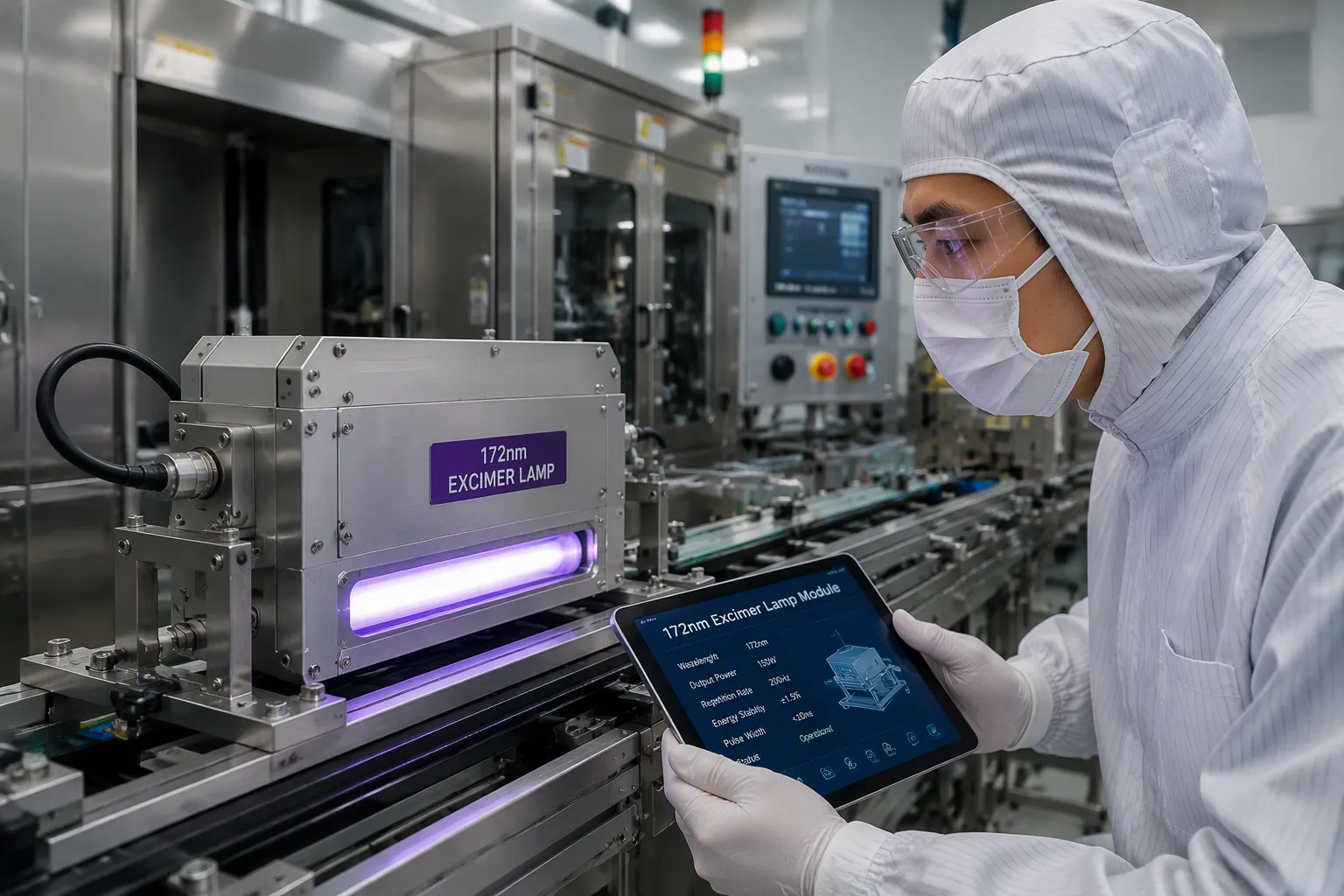
Lifetime directly impacts your maintenance schedule. A short-lived lamp forces frequent replacements and production stops. Cooling requirements demand careful planning. For high-throughput production lines, water cooling systems can be integrated to extend continuous operation of 172nm excimer lamps to 24 hours.
For high-throughput production lines, water cooling systems can be integrated to extend continuous operation of 172nm excimer lamps to 24 hours.
This capability supports round-the-clock manufacturing of ev charging components.
Matching the lamp to EV charging applications
You must match the industrial 172nm excimer lamp to your specific application. A 172nm Excimer Lamp Module designed for laboratory use will fail in a factory environment. GMY provides excimer lamps designed for industrial reliability in ev charging manufacturing. Their products address the demanding conditions of continuous production.
Total cost of ownership extends beyond purchase price. You must calculate lamp replacement frequency, downtime costs, and energy consumption. A cheaper excimer lamp that fails every few months costs more than a premium lamp that runs for years. Maintenance access matters too. Can your technicians replace the lamp without disassembling the entire charging station? Integration with existing ev charging station designs requires careful planning. The lamp module must fit your production line without major modifications.
The right 172nm excimer lamp ensures consistent performance and safety in ev charging equipment. A public charger that fails because of poor capacitor film quality damages your reputation. Public charging stations depend on reliable components. Whether you build AC chargers or dc fast charging equipment, the electric vehicle industry expects dependable products. Your ev charging business grows when your chargers perform flawlessly. Every charging session reflects the quality of your manufacturing. A charger built with precision components keeps customers returning. The ev market rewards manufacturers who prioritize quality. Your charging infrastructure investment pays off when you select the right excimer lamp from the start.
You now understand how ev chargers work and how ev charging delivers power to the battery. That knowledge guides your 172nm excimer lamp choice. Industrial buyers must weigh technical specifications, application fit, and total cost of ownership. A 172nm excimer lamp from GMY supports reliable ev charging infrastructure, whether you build a public charger, a charging station, or dc fast charging equipment for every electric vehicle. Consult GMY today. Your excimer lamp decision shapes public charging stations and each ev charger you ship.
FAQ
What wavelength does a 172nm excimer lamp emit?
It emits at 172nm. This wavelength supports ev equipment production. Each ev charger benefits from precise surface treatment. Every ev part matters.
Why does cooling matter for an industrial 172nm excimer lamp?
Water cooling extends continuous operation to 24 hours. This helps you build ev chargers without stops. Every ev charging line needs a stable charger design.
How does lamp lifetime affect ev charger manufacturing?
A short-lived excimer lamp forces frequent replacements. That downtime raises costs for each ev charger. Choose a durable 172nm Excimer Lamp Module for ev charging production.