Traditional UV Lamps vs 172nm Excimer Lamps A Comparison
Nov 06, 2026
Ultraviolet technology is widely used in industrial manufacturing, surface treatment, water purification, printing, coating, and disinfection. However, not all UV light sources work in the same way. Traditional UV lamps, including mercury-based UV lamps, and 172nm excimer lamps differ significantly in wavelength, emission characteristics, photochemical effects, and suitable applications.
For manufacturers evaluating a new UV process, choosing the right light source is not simply a matter of comparing lamp power or output intensity. The more important question is whether the wavelength and radiation characteristics can achieve the required chemical reaction, surface condition, or treatment result.
So, what is the difference between traditional UV lamps and 172nm excimer lamps? Traditional UV sources remain effective for many established curing and disinfection processes, while 172nm vacuum ultraviolet (VUV) technology offers specific advantages in organic contaminant removal, surface activation, and specialized coating modification.
GMY Lighting Technology Co., Ltd. develops 172nm excimer lamps and UV light modules for industrial applications, including semiconductor cleaning, surface modification, photocuring, and ultrapure water treatment. This comparison explains how the two technologies work, where they differ, and how manufacturers can determine which UV source is more suitable for their production requirements.
What Are Traditional UV Lamps?
Traditional UV lamps refer to established ultraviolet light sources used in industrial, commercial, and environmental applications. Depending on the lamp design, they may emit a relatively broad spectrum or concentrate their output around specific ultraviolet wavelengths.
Mercury vapor lamps are a common example. Low-pressure mercury lamps are widely associated with emission lines around 185nm and 254nm, while medium-pressure mercury lamps produce a broader range of UV wavelengths. Different lamp types are selected according to the photochemical reaction or treatment process required.
Traditional UV lamps are commonly used for:
UV curing of inks, coatings, adhesives, and printing materials.
UV-C disinfection of air, water, and exposed surfaces.
Photochemical oxidation and organic contaminant treatment.
Industrial water and wastewater treatment.
General UV processing in manufacturing equipment.
One important advantage of conventional UV technology is its established industrial infrastructure. Many production lines already use mercury UV lamps, with compatible power supplies, reflectors, cooling systems, and process parameters.
For example, GMY provides different mercury UV lamps for applications including water treatment and UV disinfection. These products serve different requirements from specialized 172nm VUV sources and should be evaluated according to the intended process.
The performance of a traditional UV lamp depends on its emission spectrum, irradiance, operating conditions, lamp age, distance from the target, and the optical properties of the material being treated. Therefore, the term traditional UV lamp covers several technologies rather than one standardized light source.
What Is a 172nm Excimer Lamp?
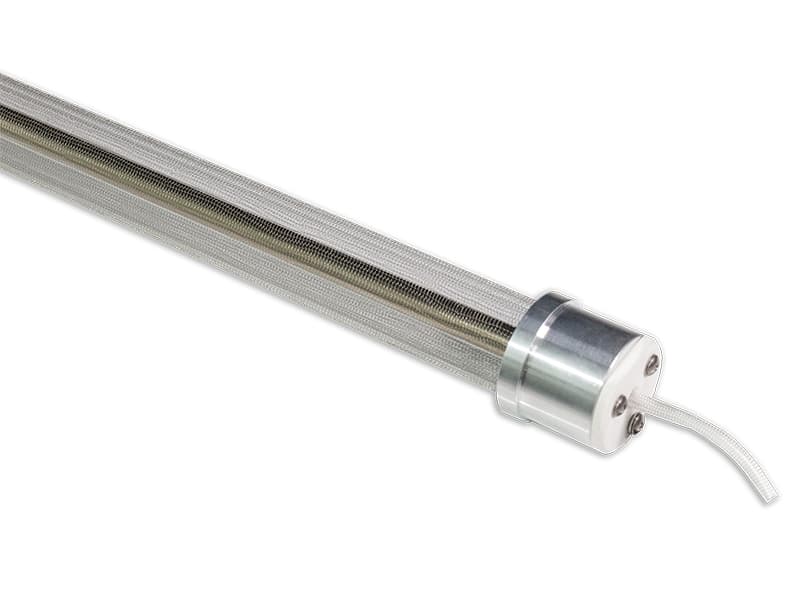
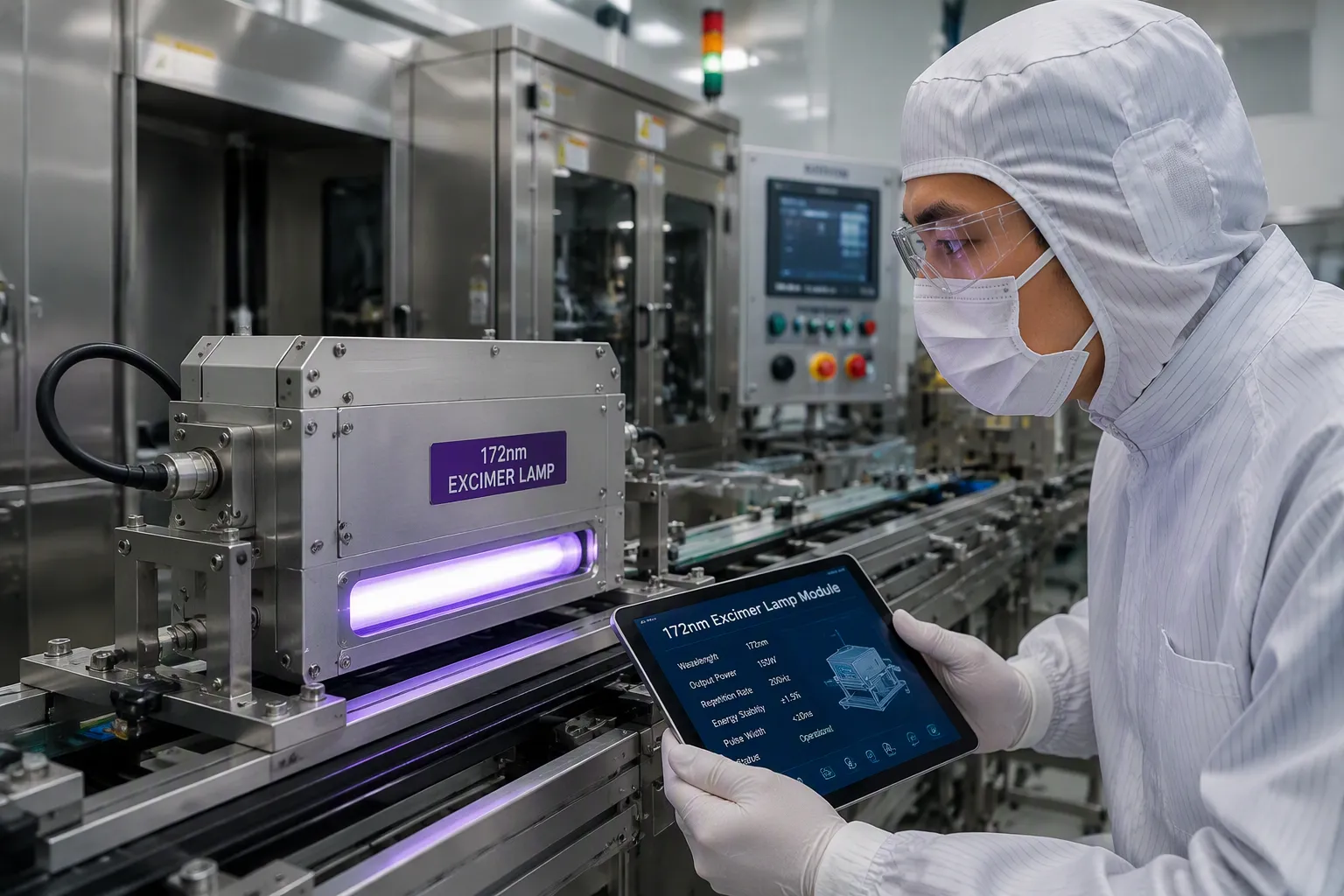
A 172nm excimer lamp is a vacuum ultraviolet light source that emits narrow-band radiation centered around 172 nanometers. It is commonly based on xenon excimer discharge technology and produces high-energy VUV photons for specialized photochemical processes.
At 172nm, the photon energy is approximately 7.2 eV. This relatively high photon energy allows the radiation to initiate photochemical reactions that are useful for breaking down organic contaminants and modifying material surfaces.
Unlike many conventional UV processes that rely on photoinitiators or longer-wavelength radiation, 172nm excimer technology can directly contribute to the decomposition of organic molecules at exposed surfaces. It can also interact with oxygen and water molecules in the surrounding environment, producing reactive species that participate in oxidation reactions.
This makes 172nm excimer lamps particularly relevant to processes where surface cleanliness, surface energy, or controlled photochemical modification is more important than deep penetration into a thick material.
GMY's 172nm Excimer VUV Light Source is designed for semiconductor wafers, display substrates, optical components, and other precision surface-processing applications.
Depending on the model, GMY's product specifications include power ratings from 5W to 1000W, with different tube dimensions, cooling methods, emission lengths, and irradiance levels. Custom specifications for lamp power, size, and matching power supplies are also available according to application requirements.
Traditional UV Lamps vs. 172nm Excimer Lamps: Key Differences
The main difference between traditional UV lamps and 172nm excimer lamps is their spectral output and the way their radiation interacts with materials. Traditional UV sources cover multiple wavelength ranges and support a broad range of established processes. A 172nm excimer lamp provides a more specific VUV output for targeted surface photochemistry.
Comparison Factor
Traditional UV Lamps
172nm Excimer Lamps
Wavelength
Varies by lamp type, such as 185nm, 254nm, or broad-spectrum UV
Narrow-band VUV output centered around 172nm
Photon Energy
Depends on the emitted wavelength
Approximately 7.2 eV per photon
Main Mechanism
Photochemical reactions, photoinitiator activation, or germicidal effects depending on the source
High-energy VUV photochemistry and surface oxidation
Penetration
Depends on wavelength, material, and formulation
Strongly surface-oriented because 172nm radiation is readily absorbed by air and many materials
Surface Cleaning
Available with suitable UV oxidation systems
Well suited to removing thin organic contamination from exposed surfaces
Surface Modification
Possible depending on wavelength and process chemistry
Useful for surface activation, hydrophilicity, and adhesion improvement
Industrial Applications
General curing, printing, disinfection, and water treatment
Precision cleaning, surface modification, specialized curing, and VUV oxidation
Mercury Content
Mercury-based lamps contain mercury
GMY's 172nm excimer lamps are mercury-free
This comparison is a general technical guide. Traditional UV lamps cover several different technologies, so the actual performance of a specific lamp should always be evaluated using its spectral output and product specifications.
How Wavelength Affects UV Processing Performance
Wavelength is one of the most important factors when selecting an industrial UV light source. It determines photon energy and influences how radiation is absorbed by the target material, coating, surrounding gas, and process medium.
Shorter wavelengths generally carry more energy per photon. However, higher photon energy does not automatically mean better performance for every application. The absorption characteristics of the material and the required reaction must also be considered.
For example, 172nm VUV radiation is strongly absorbed by oxygen and many organic materials. This makes it useful for surface-focused photochemical reactions, but it also means that the lamp generally needs to operate close to the target surface under suitable atmospheric or controlled-gas conditions.
By comparison, longer-wavelength UV radiation may penetrate certain coatings or materials more effectively, depending on their optical properties and the formulation being processed.
For manufacturers, the correct question is therefore not simply which UV lamp has the highest photon energy. It is which wavelength provides the required reaction at the correct depth, within the available process conditions.
Why 172nm Excimer Lamps Are Used for Precision Surface Cleaning
Organic contamination on material surfaces can affect bonding, coating adhesion, wettability, and downstream manufacturing quality. Even a thin layer of organic residue may create problems in processes that require clean and consistent interfaces.
172nm excimer lamps offer a dry photochemical cleaning method for removing organic contaminants from exposed surfaces. High-energy VUV photons can break molecular bonds, while oxygen-related reactions help oxidize organic residues into smaller compounds.
Typical applications include:
Semiconductor wafer cleaning: Removing organic contamination before bonding, coating, or other precision processing steps.
Photomask and FMM cleaning: Supporting the removal of organic residues from fine metal masks and photomasks.
Display substrate treatment: Preparing glass and other display materials for subsequent manufacturing processes.
Optical component cleaning: Improving surface cleanliness before coating or assembly.
Battery material modification: Supporting surface cleaning and activation for selected battery-related materials.
GMY offers specialized 172nm excimer lamp modules for semiconductor cleaning, mask treatment, surface modification, and other industrial applications.
For applications involving delicate substrates, process validation is essential. Irradiance, exposure time, lamp-to-surface distance, gas conditions, and substrate compatibility should be evaluated before production deployment.
172nm Excimer Lamps for Surface Activation and Photocuring
Beyond cleaning, 172nm excimer technology can also be used to modify surface properties and initiate selected photochemical reactions in coatings and polymer systems.
Surface activation is particularly useful when a material requires improved wettability or adhesion before a subsequent coating, bonding, or deposition process. By removing surface contamination and changing surface chemistry, VUV treatment can help prepare a material for the next manufacturing step.
In coating applications, 172nm excimer radiation can contribute to surface crosslinking and controlled surface texture formation. Depending on the coating formulation and process design, this may help create matte finishes, anti-fingerprint characteristics, or specific surface effects.
GMY's product portfolio includes high-power 172nm excimer solutions for applications such as:
Paint protection films and automotive coatings.
Soft-touch panels and decorative surfaces.
Paper and packaging inks.
Furniture coatings and industrial inks.
PCB inks and adhesive coatings.
Selected 3D printing and polymer coating processes.
For some coating systems, excimer treatment may be integrated with conventional UV curing. The excimer stage can create a specific surface effect, while a subsequent UV process completes curing through the coating layer. The actual sequence depends on the coating chemistry and production requirements.
This is an important distinction: 172nm excimer lamps are not automatically a replacement for every conventional UV curing lamp. They are often most effective when used for a specific surface reaction within a properly designed process.
172nm Excimer Technology for Ultrapure Water TOC Reduction
Another important application of 172nm VUV technology is the treatment of ultrapure water. In semiconductor manufacturing, pharmaceutical production, and laboratory systems, trace organic contaminants can affect water quality and downstream processes.
Total organic carbon (TOC) is a key parameter used to evaluate organic contamination in water. A 172nm excimer light source can promote photochemical reactions that break down organic compounds and generate reactive species that contribute to oxidation.
GMY provides a dedicated 172nm excimer lamp for ultrapure water TOC degradation. The product range includes 15W and 20W models, with a listed UV irradiance greater than 23 mW/cm² at 6mm.
These lamps are designed for water-treatment applications where compact VUV light sources can be integrated into suitable treatment systems. Their use requires consideration of reactor design, water flow, exposure conditions, optical transmission, and the characteristics of the organic contaminants.
For semiconductor UPW systems, laboratory water equipment, and other high-purity applications, the treatment system should be validated using actual water quality measurements rather than relying only on lamp power or nominal wavelength.
When Should You Choose a Traditional UV Lamp?
Traditional UV lamps remain a practical choice for many industrial processes. If your production line already uses a compatible mercury UV system and the existing wavelength achieves the required curing, disinfection, or oxidation performance, replacing it may not provide a meaningful operational benefit.
Traditional UV lamps may be more suitable when:
Your coating formulation is designed for conventional UV curing wavelengths.
You need UV-C radiation for established air, water, or surface disinfection systems.
Your process requires a specific emission spectrum or penetration profile.
Your equipment is already optimized for an existing mercury UV lamp.
Your application does not require the specialized surface photochemistry associated with 172nm VUV radiation.
For example, GMY's mercury lamp product range includes 185nm TOC reduction lamps and UV-C germicidal products. These products address different treatment requirements and should not be confused with 172nm excimer sources.
The best choice depends on the process objective, not on whether a lamp is considered traditional or advanced.
When Is a 172nm Excimer Lamp the Better Choice?
A 172nm excimer lamp is worth evaluating when the production process requires high-energy VUV photochemistry, precision organic contaminant removal, or surface modification that is difficult to achieve with the existing UV source.
It may be particularly relevant when:
You need to remove thin organic contamination from a precision material surface.
You want to improve surface wettability or prepare a material for bonding and coating.
Your process involves semiconductor wafers, display substrates, photomasks, or optical components.
You need a specialized VUV source for selected coating or surface-curing applications.
You are developing an ultrapure water system requiring advanced organic contaminant oxidation.
You prefer a mercury-free light source for the relevant industrial process.
However, 172nm radiation has important engineering considerations. It is strongly absorbed by air, and its interaction with oxygen can generate ozone. Therefore, lamp installation, gas flow, shielding, exhaust ventilation, and operator protection must be designed according to the application and relevant safety requirements.
Because VUV radiation is strongly surface-oriented, it is also not suitable for every thick-film curing or deep-penetration application. Testing with the actual substrate and process chemistry is the most reliable way to determine whether it offers a measurable advantage.
How to Select the Right UV Light Source for Your Production Line
Before selecting a traditional UV lamp or 172nm excimer lamp, manufacturers should define the process objective and identify the performance requirements that matter most.
The following factors can help guide the evaluation:
Identify the Required Treatment Result
Determine whether the main objective is curing, disinfection, organic contaminant removal, surface activation, hydrophilic modification, or TOC reduction. Different objectives require different wavelengths and process configurations.
Evaluate the Material and Its Surface Properties
Consider the substrate material, coating composition, thickness, optical absorption, temperature sensitivity, and surface condition. These factors influence how effectively the UV radiation can reach and react with the target material.
Check Irradiance and Exposure Requirements
Lamp power alone does not determine process performance. Irradiance at the working distance, exposure time, lamp geometry, beam uniformity, and total delivered dose all need to be considered.
Review Equipment Integration Requirements
Confirm the available installation space, power supply, cooling method, gas conditions, ventilation, shielding, and control interface. For 172nm systems, the optical path and atmosphere around the treatment area are particularly important.
Request Application Testing
Before committing to a production system, test the selected light source using representative samples. Measure the results that matter to your process, such as surface cleanliness, contact angle, adhesion, coating appearance, or TOC concentration.
For customized industrial systems, GMY can discuss lamp dimensions, power requirements, and matching power supplies according to the intended application. Buyers can share their process details through the GMY contact page to explore suitable UV and VUV solutions.
Why Consider GMY for 172nm Excimer Lamp Solutions?
GMY Lighting Technology Co., Ltd. is a lighting technology manufacturer based in Guangdong, China. The company develops and supplies ultraviolet, infrared, halogen, IPL, and LED lighting products for industrial and commercial applications.
GMY's 172nm excimer product range covers several application areas, including:
Semiconductor wafer and photomask cleaning.
FMM and Invar mask surface treatment.
Display substrate and optical component cleaning.
Industrial coating modification and photocuring.
Hydrophilic surface activation.
Ultrapure water TOC reduction.
The company offers different lamp configurations and product models to support varied installation requirements. Its published 172nm VUV specifications include multiple power levels, tube dimensions, cooling methods, and emission lengths. Custom lamp dimensions, power, and matching power supplies can also be discussed according to the application.
For engineering teams, selecting a lamp is only one part of the process. The optical arrangement, operating environment, control system, and treatment parameters also influence the final result. Working with a supplier that can discuss these factors is useful when evaluating a new VUV application.
To explore GMY's available models and application options, visit the 172nm Excimer Lamp product category or review the detailed product specifications on the website.
Traditional UV Lamps vs. 172nm Excimer Lamps: Frequently Asked Questions
What is the main difference between traditional UV lamps and 172nm excimer lamps?
The main difference is their wavelength and photochemical behavior. Traditional UV lamps cover different wavelength ranges and are used for general curing, disinfection, and oxidation. A 172nm excimer lamp emits narrow-band vacuum ultraviolet radiation that is particularly useful for surface cleaning, surface activation, and specialized photochemical processes.
Is a 172nm excimer lamp better than a traditional mercury UV lamp?
Not for every application. A 172nm excimer lamp may be more suitable for precision surface cleaning and modification, while traditional mercury UV lamps remain effective for many established curing, disinfection, and water-treatment processes. The correct choice depends on the material, process objective, and required wavelength.
What is the photon energy of a 172nm excimer lamp?
A 172nm photon carries approximately 7.2 electron volts (eV) of energy. This high photon energy supports photochemical reactions involved in organic contaminant decomposition and surface modification.
Can a 172nm excimer lamp replace a conventional UV curing lamp?
Not universally. A 172nm excimer lamp is often used for surface-focused photochemical reactions, while conventional UV curing systems may be needed for curing through thicker coating layers. Some industrial coating lines use excimer treatment together with a conventional UV curing stage.
What materials can be treated with 172nm excimer lamps?
Depending on the process conditions, 172nm excimer lamps can be used for surface cleaning and modification of semiconductor wafers, display substrates, optical components, metals, battery-related materials, and selected polymer or coating surfaces. Material compatibility and treatment results should be confirmed through testing.
Why is 172nm radiation suitable for organic contaminant removal?
High-energy VUV photons can break molecular bonds in organic contaminants. Reactions involving oxygen and other surrounding molecules can further oxidize the residues, helping clean exposed material surfaces without relying on conventional wet chemical cleaning.
Do 172nm excimer lamps generate ozone?
172nm radiation can interact with oxygen in the surrounding atmosphere and generate ozone. System design should therefore consider the operating atmosphere, enclosure, exhaust ventilation, and applicable safety requirements.
Are GMY 172nm excimer lamps mercury-free?
Yes. GMY describes its 172nm excimer lamps as mercury-free VUV light sources. This is different from conventional mercury-based UV lamps, which contain mercury as part of their discharge technology.
What should I provide when requesting a customized 172nm excimer lamp?
Provide the intended application, target material, required treatment result, installation dimensions, available power supply, working distance, cooling conditions, and expected operating environment. These details help the supplier evaluate suitable lamp configurations and integration requirements.
{
"@context": "https://schema.org",
"@type": "BlogPosting",
"headline": "Traditional UV Lamps vs 172nm Excimer Lamps: A Comparison",
"description": "Compare traditional UV lamps and 172nm excimer lamps by wavelength, photon energy, photochemical mechanisms, surface treatment performance, industrial applications, and system selection.",
"author": {
"@type": "Organization",
"name": "GMY Lighting Technology"
},
"publisher": {
"@type": "Organization",
"name": "GMY Lighting Technology Co., Ltd.",
"url": "https://www.gmyok.com/"
},
"mainEntityOfPage": {
"@type": "WebPage",
"@id": "https://www.gmyok.com/"
},
"about": [
{
"@type": "Thing",
"name": "Traditional UV Lamps"
},
{
"@type": "Thing",
"name": "172nm Excimer Lamps"
},
{
"@type": "Thing",
"name": "Vacuum Ultraviolet Technology"
},
{
"@type": "Thing",
"name": "UV Surface Cleaning"
},
{
"@type": "Thing",
"name": "Surface Modification"
},
{
"@type": "Thing",
"name": "UV Photocuring"
}
]
}
{
"@context": "https://schema.org",
"@type": "FAQPage",
"mainEntity": [
{
"@type": "Question",
"name": "What is the main difference between traditional UV lamps and 172nm excimer lamps?",
"acceptedAnswer": {
"@type": "Answer",
"text": "The main difference is their wavelength and photochemical behavior. Traditional UV lamps cover different wavelength ranges and are used for general curing, disinfection, and oxidation. A 172nm excimer lamp emits narrow-band vacuum ultraviolet radiation that is particularly useful for surface cleaning, surface activation, and specialized photochemical processes."
}
},
{
"@type": "Question",
"name": "Is a 172nm excimer lamp better than a traditional mercury UV lamp?",
"acceptedAnswer": {
"@type": "Answer",
"text": "Not for every application. A 172nm excimer lamp may be more suitable for precision surface cleaning and modification, while traditional mercury UV lamps remain effective for many established curing, disinfection, and water-treatment processes. The correct choice depends on the material, process objective, and required wavelength."
}
},
{
"@type": "Question",
"name": "What is the photon energy of a 172nm excimer lamp?",
"acceptedAnswer": {
"@type": "Answer",
"text": "A 172nm photon carries approximately 7.2 electron volts (eV) of energy. This high photon energy supports photochemical reactions involved in organic contaminant decomposition and surface modification."
}
},
{
"@type": "Question",
"name": "Can a 172nm excimer lamp replace a conventional UV curing lamp?",
"acceptedAnswer": {
"@type": "Answer",
"text": "Not universally. A 172nm excimer lamp is often used for surface-focused photochemical reactions, while conventional UV curing systems may be needed for curing through thicker coating layers. Some industrial coating lines use excimer treatment together with a conventional UV curing stage."
}
},
{
"@type": "Question",
"name": "What materials can be treated with 172nm excimer lamps?",
"acceptedAnswer": {
"@type": "Answer",
"text": "Depending on the process conditions, 172nm excimer lamps can be used for surface cleaning and modification of semiconductor wafers, display substrates, optical components, metals, battery-related materials, and selected polymer or coating surfaces. Material compatibility and treatment results should be confirmed through testing."
}
},
{
"@type": "Question",
"name": "Why is 172nm radiation suitable for organic contaminant removal?",
"acceptedAnswer": {
"@type": "Answer",
"text": "High-energy VUV photons can break molecular bonds in organic contaminants. Reactions involving oxygen and other surrounding molecules can further oxidize the residues, helping clean exposed material surfaces without relying on conventional wet chemical cleaning."
}
},
{
"@type": "Question",
"name": "Do 172nm excimer lamps generate ozone?",
"acceptedAnswer": {
"@type": "Answer",
"text": "172nm radiation can interact with oxygen in the surrounding atmosphere and generate ozone. System design should therefore consider the operating atmosphere, enclosure, exhaust ventilation, and applicable safety requirements."
}
},
{
"@type": "Question",
"name": "Are GMY 172nm excimer lamps mercury-free?",
"acceptedAnswer": {
"@type": "Answer",
"text": "Yes. GMY describes its 172nm excimer lamps as mercury-free VUV light sources. This is different from conventional mercury-based UV lamps, which contain mercury as part of their discharge technology."
}
},
{
"@type": "Question",
"name": "What should I provide when requesting a customized 172nm excimer lamp?",
"acceptedAnswer": {
"@type": "Answer",
"text": "Provide the intended application, target material, required treatment result, installation dimensions, available power supply, working distance, cooling conditions, and expected operating environment. These details help the supplier evaluate suitable lamp configurations and integration requirements."
}
}
]
}